I have a confession that starts with a 2008 Honda Accord and a lug nut that took a four-foot breaker bar and most of my body weight to break loose. The guy who had the wheels off before me ran an impact wrench and apparently never heard of a torque stick. He left every stud stretched and every wheel fighting me. That was the day I stopped trusting my arms and started trusting a number, and it's the reason an EPAuto 1/2-inch Drive Click Torque Wrench lives in my rolling tool chest now.
Here's the problem with lug nuts in plain terms. Too loose and the wheel can wobble, the studs can work themselves loose over a few hundred miles, and you are betting a wheel stays on at highway speed. Too tight and you stretch the studs, warp a brake rotor, or turn your next flat tire into a two-hour fight that ends with a stripped nut and a tow truck. The factory spec for most cars, trucks and SUVs on the road sits somewhere in the 80 to 100 ft-lb range, and a click-type torque wrench gets you to that number without any guessing.
The torque wrench I reach for on every wheel-off job
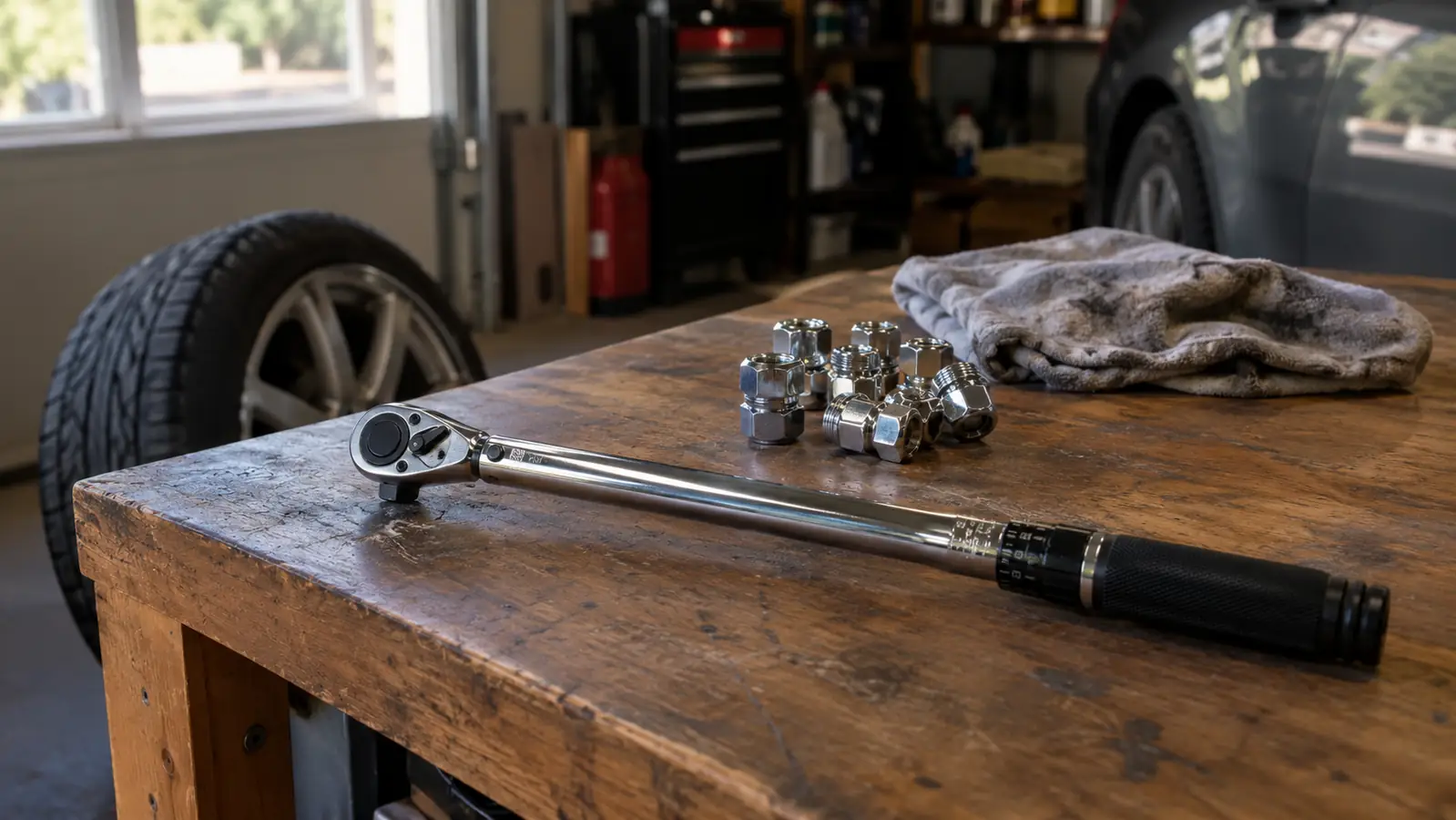
The EPAuto 1/2-inch Drive Click Torque Wrench covers 10 to 150 ft-lb, which handles everything from lug nuts to suspension bolts on the kind of vehicles most of us actually work on. It is pre-calibrated to ±4%, clicks when you hit the number, and comes with a 5-inch extension bar and a plastic storage case.
Amazon Check Today's Price on Amazon →The Right Way to Torque a Wheel
The process is the same whether I'm putting a spare on my F-150 or doing a brake job on my daughter's Accord. Work in order, use the numbers on the sticker, and let the wrench tell you when to stop. Here are the five steps I follow every time.
Step 1: Find the Right Torque Spec for Your Vehicle
The number you need is usually printed on a sticker in the driver's door jamb, inside the glove box, or in the owner's manual. It is not a guess and it is not the same for every vehicle. My truck calls for a higher number than my daughter's Accord, and that difference is exactly why you set the wrench fresh for every job instead of leaving it where it was.
If the sticker is gone and the manual is long lost, look up the spec online before you start. It takes two minutes and it is the difference between a wheel that's held on right and a wheel that's held on at the wrong tension. Write the number down or take a picture of the sticker with your phone. You will want it again in an hour.
One thing I tell people who are new to this: the torque spec is for clean, dry threads. If you're torquing a wheel that's been on for years and the studs are greasy, the numbers won't mean the same thing. That's why the cleaning step comes before the torquing step. Get the threads and the hub face clean, use the factory number, and the click means what it says.
Step 2: Break the Lugs Loose Before You Jack It Up
A click torque wrench is for tightening, not for breaking things loose. The EPAuto clicks at the preset value and then gives, which is exactly what you want when you're torquing a wheel and exactly the wrong tool for cracking a seized lug nut. So the order matters: loosen the lugs while the wheel is still on the ground, then jack the car up.
Use a breaker bar or a four-way lug wrench and break each nut loose about a half turn while the vehicle's weight is still on it. That half turn is what breaks the corrosion and the clamping force. If a nut is seized, a shot of penetrating oil and a little patience beats forcing it with a longer pipe. Once every lug is loose, then you can jack the car up and finish removing them by hand.
Step 3: Clean the Studs and the Hub Face
Before anything goes back on, take a wire brush to the studs and the face of the hub. Rust, old anti-seize and crud build up between the wheel and the hub, and that buildup changes how the wheel sits and how the torque reads. You want bare metal on metal, clean and dry.
I keep a dedicated wire brush hanging on my pegboard for this. It takes thirty seconds a wheel and it has saved me from more than one wheel that needed a second torque pass after a hundred miles because a little rust settled. If you use anti-seize on lug studs, go easy with it. A thin film is plenty. A heavy coat changes the torque reading and can leave you with a wheel that's tighter than the number on the wrench says.
Step 4: Set the Wrench to the Spec and Work the Star Pattern
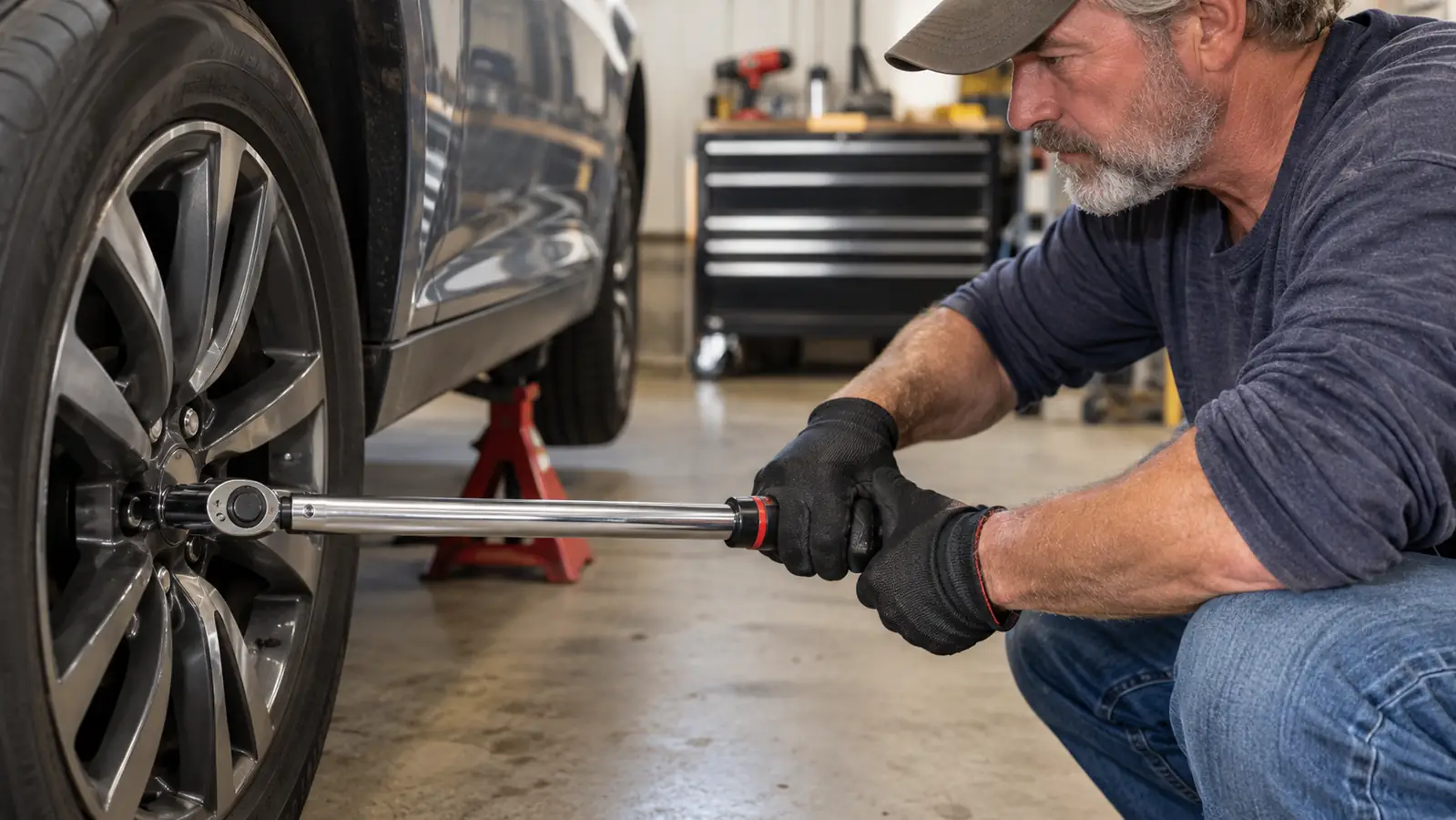
Now you're ready to put the wheel on. Hand-thread every lug nut until it's snug, then set the wrench to the torque value you wrote down. The EPAuto is pre-calibrated to ±4%, so the value you set is the value you get. When you reach that preset value, you'll hear a click and the wrench will give, which is your signal to stop.
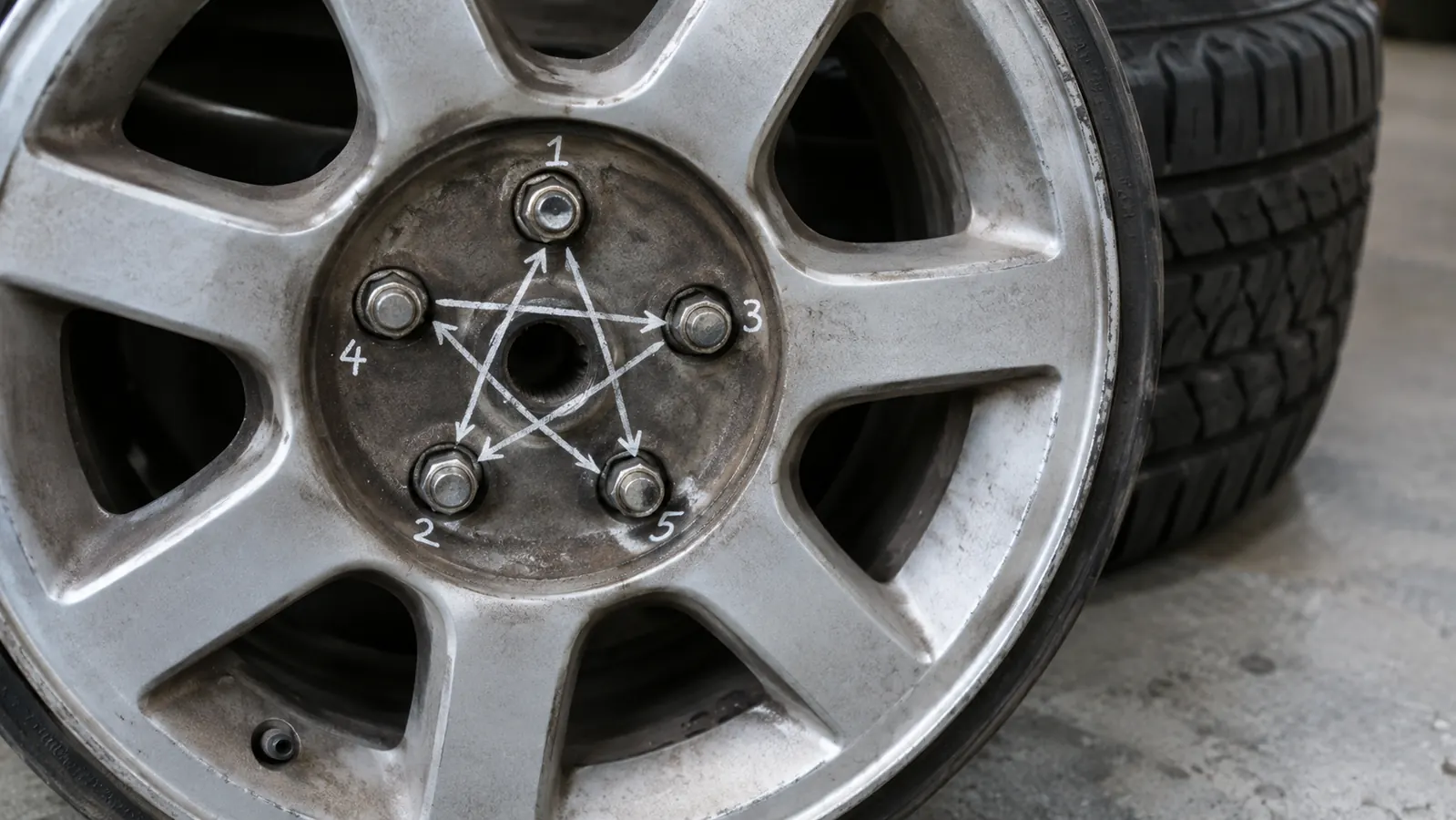
Tighten in a star pattern, not in a circle. On a five-lug wheel, that means going to the lug that's one over from the last one, which draws the wheel down evenly and keeps it seated flat against the hub. On a four-lug wheel, work across in an X. On a six-lug wheel, skip one each time. The pattern matters more than people think, because a wheel drawn down unevenly can sit with a slight wobble that no amount of final torque will fix.
Do two passes. The first pass, run every lug to about half the final value, just snugging the wheel down in the star pattern. The second pass, go around again at the full spec. That two-pass method is what keeps the wheel from shifting between the first and last lug, and it's the difference between a wheel that's right and a wheel that's close.
Step 5: Lower It to the Ground and Do a Final Pass
Here's where a lot of people stop early. The torque reading changes once the vehicle's weight is on the wheel, because the suspension settles and the hub loads up. So after you lower the car off the jack stands, go around the star pattern one more time at the full spec. Every lug should click within a few degrees of the same effort. If one clicks early, it was tight enough. If one never clicks, it's loose, so snug it and keep going.
Then put the torque wrench away the right way. Wipe the satin finish down with a shop rag so brake dust and oil don't sit on it, and put it back in the plastic storage case it came with. I keep mine on the shelf in the case, with the 5-inch extension bar right beside it, so the next wheel-off job starts with everything in one place.
If you're doing a brake job, the sequence is the same, just with an extra part. The caliper bracket bolts and the caliper slide pins get their own torque values, usually lower than the lug nuts. The wrench handles those too. Set it, click it, move on. One tool, three or four different numbers on the same job.
What Else Helps
A torque wrench is the last word on a wheel, but a few other things make the job easier. A four-way lug wrench or a breaker bar gets the nuts loose before you lift the car. A wire brush keeps the hub face clean. A torque spec sticker or a photo of the door jamb sticker on your phone means you never guess the number. And a 5-inch extension bar, which the EPAuto includes, gives you a little extra reach when a wheel well is tight. None of that replaces the click, but all of it makes the click the easy part.
My daughter's Accord gets its wheels torqued to spec every single time now, because I'm the one who fought that last set of studs with a breaker bar.
Re-Check After 50 Miles
New wheels, fresh rotors, or wheels that have been off for a long time can settle in the first few drives. I make it a habit to re-torque after about 50 miles, which for me is usually the next trip to town. It takes five minutes with the car on level ground. Go around the star pattern, listen for the click, and put the wrench away. That one pass has caught a loose wheel more than once in thirty years of turning wrenches.
Why the Click Matters
A beam-style torque wrench works, but you have to watch the needle while you pull, which means your eyes are on the gauge instead of the work. A click-type wrench like the EPAuto takes that problem away. You set the number, you pull, and the wrench tells you when you're there with a sound and a sudden give in the handle. You can feel it with your eyes closed, which matters when you're lying on your back with a wheel in your lap and the light is bad.
The ±4% accuracy rating matters too. That means when I set the wrench to 100 ft-lb, the actual torque at the fastener is somewhere between 96 and 104. For a lug nut, that's well inside the window the factory gives you. It isn't a lab instrument and it doesn't pretend to be. It's a shop tool that gets you reliably into the right range every single time, which is all a wheel actually needs.
What to Look For in a Torque Wrench
If you're shopping for your first one, the range is the first thing to check. A 1/2-inch drive click torque wrench in the 10 to 150 ft-lb range, like this EPAuto, covers lug nuts, suspension bolts, and most of the chassis fasteners on a car or light truck. That's the sweet spot for a driveway mechanic. A smaller 3/8-inch drive unit is handy for smaller bolts, but it won't reach the 100-plus numbers that wheels on full-size trucks want.
The length matters for leverage. This one is 16.25 inches, which is enough to get a solid pull without being so long that it's awkward in a tight wheel well. It weighs 3.5 pounds, so it has some heft to it but it's not a burden to keep in the truck. The scale reads in foot-pounds, which matches the door jamb stickers on the vehicles I work on. And the satin finish on the chrome vanadium steel shrugs off brake dust and road grime better than a shiny chrome tool that shows every fingerprint.
What a Click Torque Wrench Won't Do
It won't loosen a seized lug nut, so keep the breaker bar handy. It won't fix a wheel that's already warped or a hub that's got crud built up behind it, which is why the cleaning step matters. And it won't save you from using the wrong spec, so look the number up. What it does is take the guesswork out of the single most important step in putting a wheel back on, and it does it with a sound you can hear and a feel you can trust.
If You Only Do One Thing
If you take nothing else from this, take this: the next time a wheel comes off your car, it goes back on with a torque wrench set to the number on the sticker. Not an impact gun set to 'yes.' Not a four-way lug wrench and your best guess. The click is free, the wrench pays for itself the first time it keeps you from stretching a stud or fighting a seized nut a year from now.
Stop guessing with a breaker bar
An EPAuto 1/2-inch Drive Click Torque Wrench covers 10 to 150 ft-lb, clicks when you hit the number, and comes with the 5-inch extension bar and storage case you need to keep it ready for the next job. Set it, click it, done.
Amazon Check Today's Price on Amazon →