

The check engine light in my 2014 F-150 came on a Friday evening last spring, with the parts stores closing and the local shops already booked into the next week. My first thought was the usual one: how much is this going to cost me. My second thought was different. I grabbed the ANCEL AD310 I had picked up a few months earlier, plugged it into the port under the dash, and had my answer in about ten seconds. The code pointed at a leak in the evaporative emissions system, not the engine or the transmission, and I had the truck back on the road the same night for the cost of a gas cap.
That is the whole story of this scanner in one paragraph. It turns a vague, expensive-sounding warning into a specific part you can look at. A year later, the AD310 has paid for itself several times over, and I still reach for it before I call anyone.
The Quick Verdict
The best-selling code reader on Amazon for good reason. It reads and clears engine codes on anything from 1996 on, the 2.4-inch screen is easy to read from the driver's seat, and it has survived a year of driveway use without a complaint. It will not do the deeper work of a professional scan tool, but it was never meant to.
Amazon Check Today's Price →Read your own codes before the shop reads them for you
The ANCEL AD310 plugs into any 1996 or newer US car, light truck, or SUV, puts the code on a 2.4-inch screen in seconds, and clears it when the fix is done. A year of driveway diagnostics says it earns its spot in the glove box.
Amazon Check Today's Price on Amazon →How I've Used It
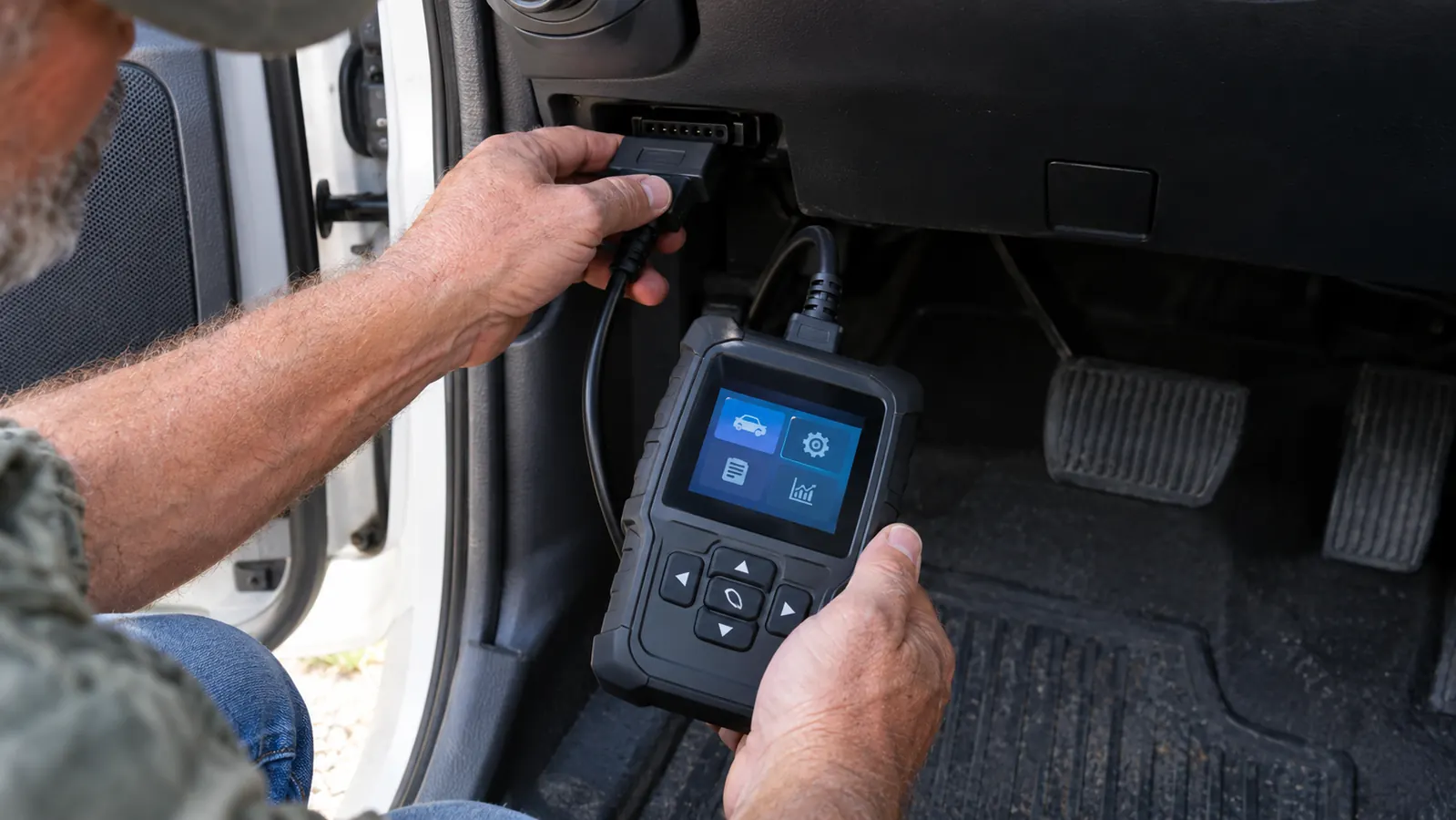
I keep the AD310 in the center console of the F-150, which is where the lights tend to come on. When the check engine light pops, I pull into the driveway, plug the scanner into the diagnostic port under the driver's side of the dash, and turn the key to the run position without starting the engine. The scanner does its thing in a few seconds and puts the code on the screen. Then I look the code up on my phone, decide whether it is a gas cap, a sensor, or a call to the shop, and go from there.
My garage is a two-car detached building with a concrete floor, one rolling tool chest, and a pegboard wall. No lift, no fancy electronics. I work on jack stands and ramps, and I have been doing it long enough to know that guessing is the most expensive tool in the box. The AD310 takes the guessing out of the first step of every diagnostic. It has read codes on both of my vehicles, the F-150 and the 2008 Honda Accord I keep running for my daughter, and it has never failed to connect.
The unit itself is simple. It weighs 12 ounces and measures 8.9 by 6.9 by 1.4 inches, so it disappears into a glove box. It is corded, which means no batteries to die and no charger to lose, and the included components are just the scanner and the manual. The buttons are clearly labelled, the screen is large for this class of tool, and everything is in plain English. There is no app to pair and no firmware to fight with. You plug it in and it works.
The first time I used it, I expected a learning curve. There was not one. You plug it in, turn the key, and the code is right there on the screen. If the computer has stored more than one code, the buttons let you scroll through them before you clear anything. The manual is short and written in plain English, which is more than I can say for a lot of tools I have bought over the years.
What the AD310 Actually Does
Let me be clear about what this tool is. The AD310 is a code reader, not a scan tool. It reads diagnostic trouble codes from the engine computer, shows them on the screen, and clears them once you have made the repair. That sounds modest, but it covers the majority of what a home mechanic actually needs. Most check engine lights are emissions-related or sensor-related, and the code tells you exactly which system is complaining.
The compatibility is the part that surprises people. The AD310 covers 1996 and newer US-based cars, 2000 and newer EU-based and Asian cars, plus light trucks and SUVs. That means it works on just about anything in my driveway and just about anything my neighbors drive. The listing calls it a universal fit, and in a year of use I have never found a vehicle it would not talk to.
It is also fast. The listing says accurate and fast, and I have found both to be true. From plug-in to code on the screen is usually a few seconds, and the screen refresh is quick when you are scrolling through stored codes. The 128 by 64 screen is text only, so do not expect graphs or gauges. What you get is the code, plain and readable.
There is also something to be said for a tool that comes with nothing to lose. The box contains the scanner and the user's manual, and that is it. No charger, because it does not need one. The power source is the cord that plugs into the car, so there are no batteries to die at the worst moment. In a year of use, the only time it has not worked is the one time I left it at home.
The F-150 Story
The code that Friday was P0455, a large leak in the evaporative emissions system. On a truck with 190,000 miles, my first guess was a cracked hose or a failing purge valve, both of which would have meant ordering parts and spending a weekend under the truck. But the AD310 gave me the system, and the cheapest part of an EVAP system is the gas cap. I checked the cap first and found the seal was worn out. A new cap, a cleared code, and the light stayed off for the rest of the summer.
That is the moment the scanner earned its keep. A shop would have started with the same code read, then charged me a diagnostic fee on top of whatever they sold me. Instead, I spent the cost of a gas cap and about ten minutes. The scanner does not fix the truck. It tells you what is wrong, and that is worth more than the fix itself.
A few months later, the light came back with a different code, P0171, which means the engine is running lean on bank one. That one took more work. I cleaned the mass air flow sensor, checked the intake hoses, and found a split boot that was letting in unmetered air. A small part and an afternoon of work later, the code cleared. Without the AD310, I would have been guessing between a dozen possible causes, and I probably would have replaced the wrong part first.
The Accord Story
The second good story came from my daughter's 2008 Accord. She called me from a gas station parking lot with the check engine light on, which is a special kind of worry when it is your kid on the side of the road. I drove over with the AD310 in my pocket, plugged it in, and got P0301, a cylinder 1 misfire. That is a very different conversation than a vague 'something is wrong with the engine.' It means the problem is isolated to one cylinder, and the usual suspects are spark plugs, ignition coils, or a fuel issue.
I had her drive it home, replaced the spark plugs that weekend, cleared the code, and the light has not come back since. Without the scanner, that car would have gone to a shop, and the shop would have started by plugging in a tool exactly like this one. Doing that step myself, in a parking lot, with a 12-ounce tool from the glove box, is the whole point.

Where It Stops Short
I want to be honest about the limits, because they matter. The AD310 reads and clears engine codes. It does not turn you into a transmission specialist, and it will not tell you how to fix an airbag system. I still send transmission rebuilds and airbag work to a shop, and I would never pretend a code reader changes that. Some codes are going to mean a phone call, and that is fine.
It is also not a professional scan tool. If you need live data streams, bidirectional control, or the ability to program a module, you are looking at a different class of tool at a different price. And because the AD310 is corded, you stay in the driver's seat while you use it. You cannot walk around the car with it. For the way I work, none of that has ever been a problem. But I would rather tell you now than have you find out after checkout.
A Year of Hard Use
The build quality has been the quiet surprise. I have dropped the AD310 on the concrete floor of my garage, left it in the center console through an Arkansas summer and winter, and stuffed it in a coat pocket on the way to a parking lot. The buttons still click, the cord is intact, and the screen still reads clearly. Twelve ounces is light enough that you forget it is in your pocket, and small enough that it never feels like it is in the way.
I also checked the numbers before I wrote this. The AD310 sits at 4.6 stars across more than 67,000 reviews on Amazon, and that matches my experience. It is one of the best-selling OBD2 scanners on the market, and it is recommended by Scotty Kilmer, a mechanic whose YouTube channel I have watched for years. I do not usually lean on popularity as a reason to buy a tool, but when tens of thousands of owners and a working mechanic all say the same thing, I listen.
I will also say this: I thought about buying a fancier scan tool more than once this year. Every time, I talked myself out of it. My work is oil changes, brakes, battery swaps, and basic diagnostics, and the AD310 covers all of it. The day I need to program a module or watch live sensor data, I will buy the bigger tool. Until then, the 12-ounce reader in the glove box is the right amount of tool for the work I actually do.
What I Liked
- Reads and clears engine codes on 1996 and newer US cars plus 2000 and newer EU and Asian models, light trucks, and SUVs
- 2.4-inch screen is easy to read from the driver's seat
- 12 ounces and small enough to live in a glove box
- Corded, so no batteries to replace and no charger to lose
- Clearly labelled buttons and plain English menus
- 4.6 stars across more than 67,000 reviews
Where It Falls Short
- It is a code reader, not a scan tool, so no live data graphs or module programming
- The cord keeps you in the driver's seat
- Some codes still mean a shop visit, and the scanner cannot change that
- Text-only 128 by 64 screen, so no fancy visuals
One code read by the AD310 turned a weekend of guessing into a ten-minute fix with a new gas cap.
Who This Is For
The AD310 is for anyone who owns a car from 1996 or newer and wants to know what a warning light actually means before they spend money. It is for the driver who does their own oil changes and brakes and wants to add diagnostics to the list. It is for the parent handing a car to a kid, because a code read in a parking lot beats a panicked phone call. And it is for the budget-minded owner who has learned that information is the cheapest part of any repair.
If you are the kind of person who reads the owner's manual before the first drive, or who has a dedicated drawer for shop rags, this scanner will fit right in. It is also a good first diagnostic tool for someone who has never owned one. There is nothing to configure and nothing to learn. If you can find the port under the dash, you can use this.
Who Should Skip It
Skip it if you will never turn a wrench and just want the light gone, because a shop can do that for you. Skip it if you need professional scan tool features like live data or programming, because this is not that tool. Skip it if you want a wireless scanner with an app, because the AD310 is corded and deliberately simple. And skip it if you expect any scanner to fix the problem. It names the problem. You still have to do the work.
Stop guessing what that light means
A year of driveway diagnostics with the ANCEL AD310 says the same thing every time: the code is the cheapest part of the repair. Read it yourself, clear it yourself, and keep the light from owning your weekend.
Amazon Check Today's Price on Amazon →