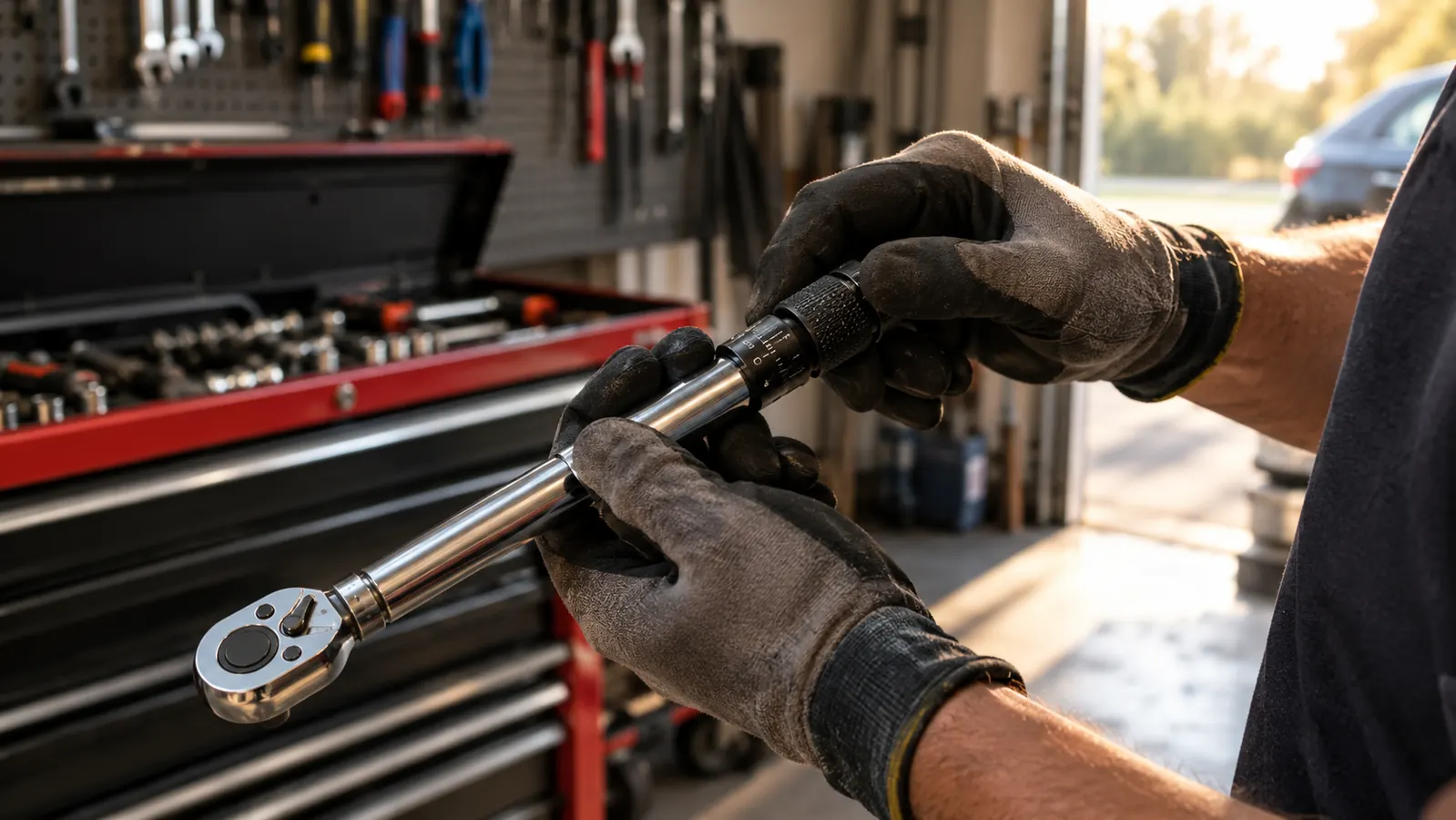
I have been turning wrenches on my own cars for over 30 years, and I will tell you straight: a torque wrench is the tool I ignored the longest and now reach for the most. The EPAuto 1/2-inch Drive Click Torque Wrench covers 10 to 150 ft-lb, which is exactly the range that matters for lug nuts, caliper brackets, strut bolts and most suspension work on a driveway. It is not a lab instrument. It is a working tool that costs a fraction of what a truck-brand equivalent runs, and after months of using it on my 2014 Ford F-150 and my daughter's 2008 Honda Accord, I know exactly where it earns its keep and where I would tell you to spend more.
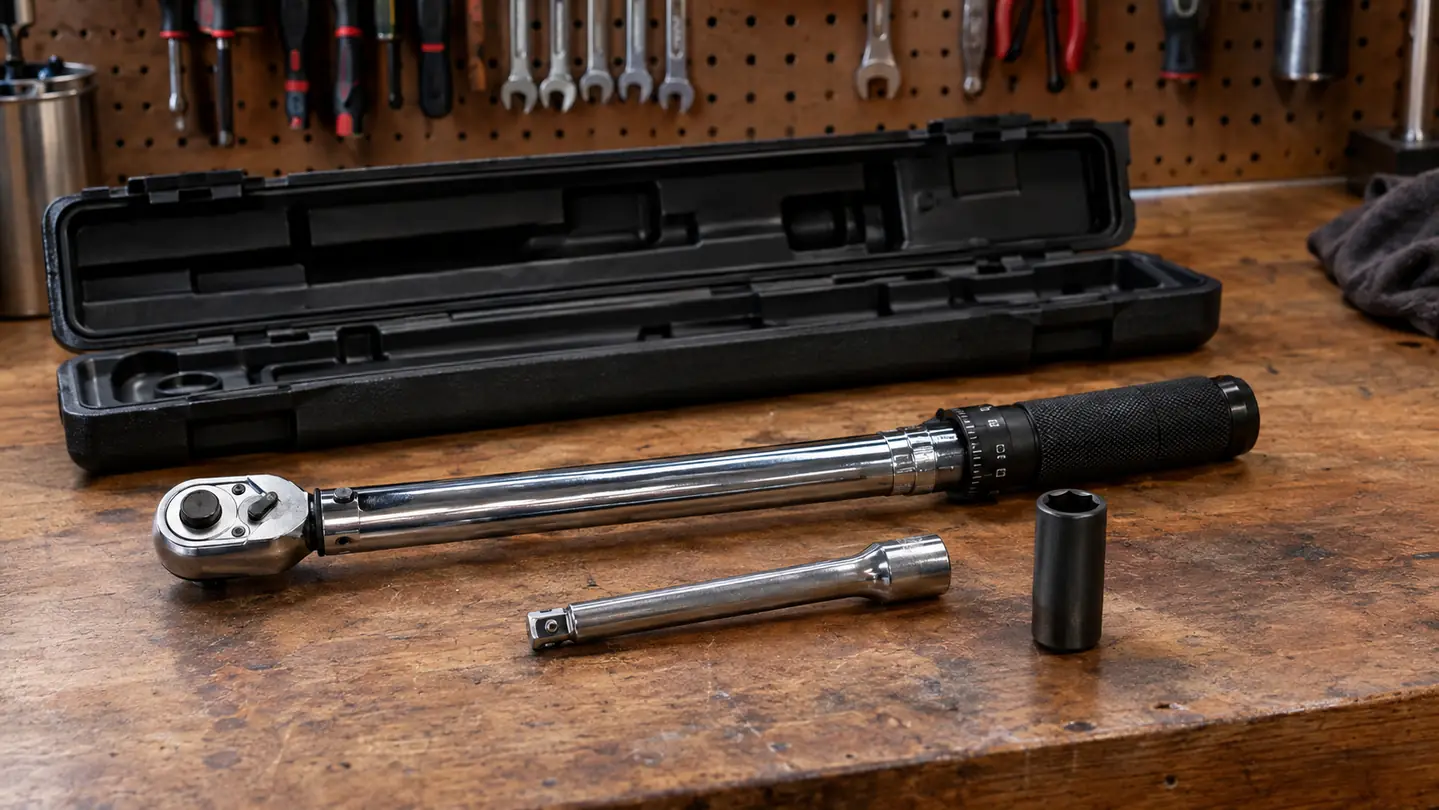
EPAuto sells this wrench with a simple promise: it is pre-calibrated to plus or minus 4 percent, it tells you the preset value is reached with a click, and it comes in a plastic storage case with a 5-inch extension bar. That is the whole story, and it is refreshingly honest. There is no app, no digital display, no auto mode to argue with. You set the number, you pull until it clicks, and you move on. For a weekend garage guy who does his own brakes and oil changes, that is most of what you need.
The Quick Verdict
The EPAuto click torque wrench is the right tool for DIY brake jobs, lug nuts and suspension work at a price that makes owning one a no-brainer, as long as you understand its 4 percent accuracy band and treat it like the precision tool it is.
Amazon Check Today's Price →Stop guessing on lug nuts and caliper bolts
The EPAuto 1/2-inch Drive Click Torque Wrench covers the 10 to 150 ft-lb range that matters for most driveway jobs, ships pre-calibrated to plus or minus 4 percent, and includes the extension bar and storage case you will actually use.
Amazon Check Today's Price on Amazon →How I've Used It
My routine with this wrench started with the job that sends most people to a shop: brakes. On my daughter's 2008 Accord, the caliper bracket bolts get torqued to a specific value, and I used to do them by feel. Feel is fine until it is not. A caliper bolt that is too loose can back out. One that is too tight can strip the knuckle. The EPAuto wrench took the guesswork out of both ends of that job. That first brake job was a front pad and rotor swap on a Saturday in March, with the Accord up on jack stands and the front wheels off. I set the wrench to the bracket bolt spec in the service manual, 80 ft-lb, and worked around all four corners. The first time I heard the click, I remember thinking that this was the first brake job in years where I did not lie awake wondering if a bolt was tight enough.
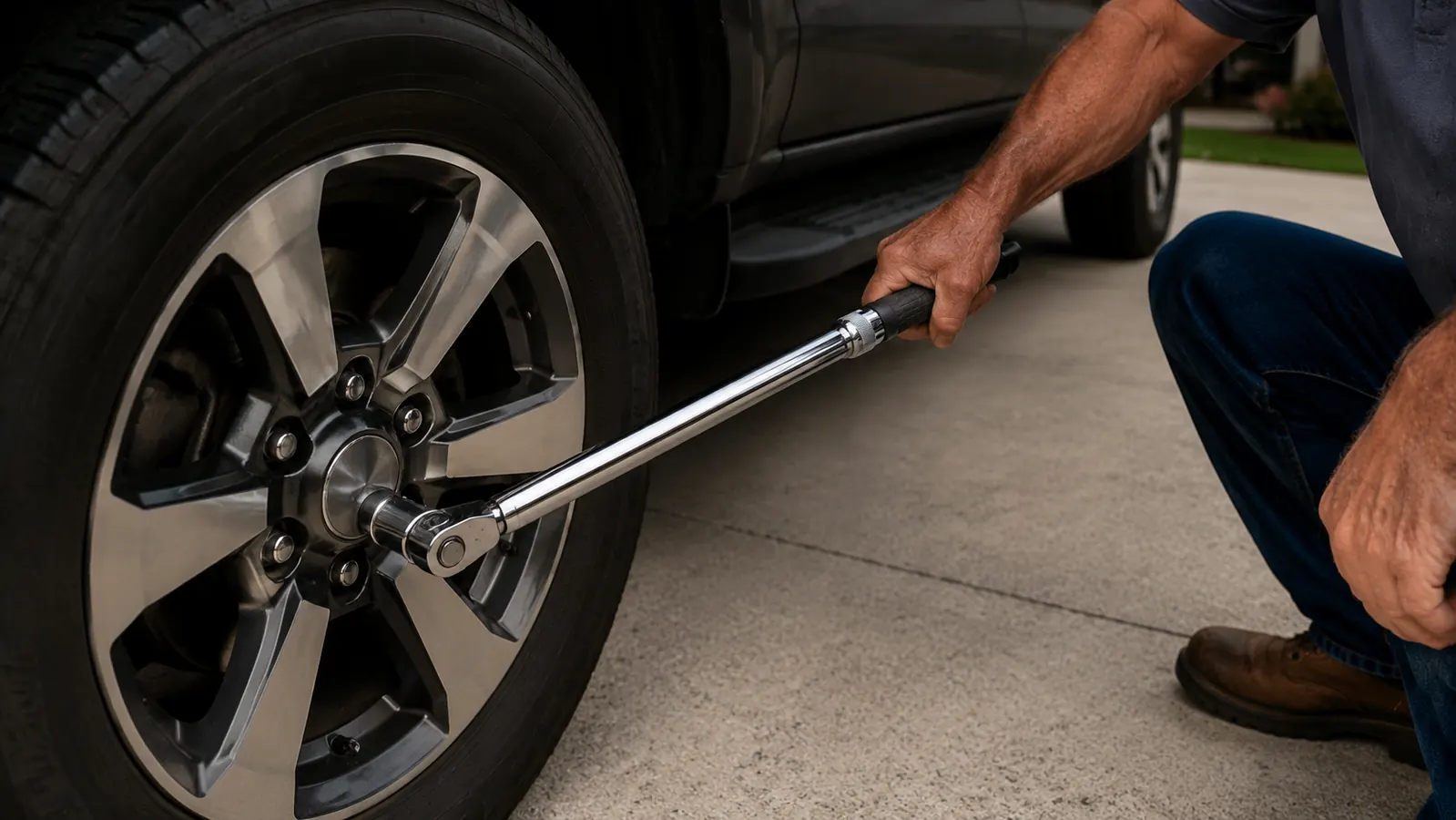
I also use it for lug nuts on both vehicles. The F-150's spec is 150 ft-lb, which is right at the top of the wrench's range. I set the EPAuto to that number, click it on each lug in a star pattern, and finish with a final pass. The click is unmistakable. It is not a subtle feel through the handle. It is an audible snap that you can hear over the sound of a running compressor in the next bay. The first time I used it on the truck, I had been doing lug nuts by feel with a four-way wrench for years, and I was honestly a little embarrassed at how easy the click made it.
The 5-inch extension bar that comes in the case has saved me more than once on recessed bolts where a socket alone would not reach. The lower strut bolts on the Accord sit recessed behind the splash shield, and without the extension I could not get the socket to seat square on the bolt head. With it, I reached in, seated it, and pulled the click without cussing. The satin finish resists the kind of surface rust you see on tools left in a damp truck bed, and the chrome vanadium steel body has held up to being dropped on a concrete floor more times than I want to admit.
I have also used it for the oil drain plug on both vehicles. The F-150's plug calls for 20 ft-lb, which sits near the bottom of the wrench's range, and the Accord's is similar. I set it there, and the click comes right as the crush washer seats. That is the job where I trust the wrench least, because 20 ft-lb is close to the bottom of its band, but it has been consistent every single time. When the click lands, the plug is snug and the washer is seated, and I have not had a drip from either pan since I started using it.
Accuracy: What Plus or Minus 4 Percent Actually Means
Here is what nobody tells you about a budget click torque wrench. The plus or minus 4 percent spec is honest, but you have to read it the right way. At 100 ft-lb, 4 percent is a band from 96 to 104 ft-lb. For a lug nut that calls for 100 ft-lb, that is well inside the safe window. For a delicate aluminum oil drain plug that calls for 18 ft-lb, the same 4 percent band is roughly 17.3 to 18.7 ft-lb, which is still fine, but it is a reminder that this tool is not a calibration standard. The EPAuto listing states the 4 percent number plainly, and it does not dress it up. That plainness is part of why I trust it. A tool that claimed lab-grade accuracy at this price would be lying to you. This one tells you exactly what it is.
I checked mine against a beam-style torque wrench a friend let me borrow, and the EPAuto clicked within a couple of foot-pounds of the mark across the middle of its range. We did the test on a Sunday afternoon in my garage, with a bolt clamped in a bench vise and both wrenches reading the same fastener. At 40, 80 and 120 ft-lb, the click came within two ft-lb of the beam's reading every time. At the very bottom of the range, below 20 ft-lb, the margin of error feels wider. I would not trust this wrench for anything that calls for less than 15 ft-lb, and for small fasteners I still reach for a beam wrench or a smaller inch-pound tool.
One thing I have learned in the months since: a click wrench only repeats what you give it. If you set it wrong, it clicks at the wrong number with the same confidence. I have started reading the setting twice before every job, once when I pick it up and once after I slide the socket on. It takes two seconds, and it has caught me twice, both times on the Accord, where I had the number in my head from a different fastener. That is not a flaw in the tool. It is the nature of any click wrench, at any price.
The click is unmistakable. It is not a subtle feel through the handle. It is an audible snap you can hear over a running compressor.
The Limits Nobody Mentions
The first limit is the adjustment mechanism. The EPAuto uses a handle that you turn to set the value, and the numbers on the shaft are printed, not laser-etched. After a year of heavy use, the markings can wear and get hard to read in bad light. I found this out on a Tuesday evening in November, doing a rear brake job on the Accord with a work light clamped to the fender. I had to hold the wrench right up to the light to confirm the setting before I pulled on it. The solution is simple: keep it in the plastic case when it is not in use, and read the setting before you start the job, not after you have already pulled on it.
The second limit is the storage case. It is sturdy plastic and it does its job, but it is not a hard-sided box you can throw in a truck bed. It is a tray-style case that keeps the wrench and the extension bar organized on a shelf or in a drawer. Treat it like a precision tool and it will stay accurate. Throw it loose in a drawer with a pile of impacts and you will be re-calibrating it sooner than you should. I keep mine on the top shelf of my rolling chest, away from the tools that get grabbed in a hurry, and the case has kept the wrench and the extension bar together for the whole time I have owned it.
The third limit is the head. It is a standard ratchet head, which means it works fine in most spaces but it is not a flex head. On a few tight spots on the Accord, I had to use a universal joint and the extension bar to get the angle I needed. The lower strut bolt on the driver's side is the one I remember best. There was no way to get the wrench square on it without the universal, and even then I had to hold the head with my fingers to keep it seated. That is not a flaw in the wrench. It is just the reality of a straight-head click wrench at this price.
There is also the length and weight to consider. The EPAuto is 16.25 inches long and weighs 3.5 pounds, which makes it a long tool even though it is not a heavy one. In tight engine bays you feel the length more than the weight. On the F-150 I have never had a problem reaching anything. On the Accord there are two spots where I have to come at the fastener from below with the extension. Neither is a dealbreaker. They are just the kind of thing nobody puts in the product description, and they are worth knowing before you buy.
Care and Storage: What Keeps It Accurate
A click torque wrench is a precision instrument even when it costs less than a dinner out. The internal mechanism that produces the click is a calibrated spring, and that spring does not care about your budget. It cares about how you store it.
The rule is simple: always wind the wrench down to its lowest setting before you put it away. If you leave it set at 150 ft-lb, the spring stays compressed and it will drift out of calibration over time. I keep mine at 10 ft-lb, the bottom of its range, with the extension bar in the case beside it. I got into this habit after reading the instruction sheet that comes in the case, which says the same thing in plainer language. The satin finish wipes clean with a rag, and I give the adjustment threads a drop of light oil once a year, usually the first weekend of spring when I do the seasonal fluid check on both vehicles.
I also do not use mine as a breaker bar. If a bolt is seized, I break it loose with a regular ratchet or a breaker bar first, then use the EPAuto for the final torque. Using a click wrench to break a stuck bolt is the fastest way to knock it out of calibration, and it is the one mistake I see driveway mechanics make over and over. Last summer I watched a neighbor use his click wrench to snap a seized lug nut loose, and then he wondered out loud why the click came early on the next wheel. That is the spring talking. Once a click wrench has been used to break something, you cannot trust the click until the wrench has been checked.
If you drop it, check it. I dropped mine off the workbench onto the concrete floor about three months in, and I spent the next weekend verifying it against the beam wrench before I trusted it again. It clicked within a foot-pound of where it had before the drop, but the check is the cost of peace of mind. A torque wrench is the one tool in the box where probably fine is not good enough, because the whole point is that you are trusting it with the bolts that hold your wheels on.
Who This Is For
This wrench is for the DIY home mechanic who does their own brakes, oil changes, battery swaps and basic suspension work and wants to stop guessing. If you have ever torqued a lug nut by feel and wondered whether it was tight enough, this is the tool that answers that question for you. The 10 to 150 ft-lb range covers lug nuts, caliper bracket bolts, strut nuts, control arm bolts and most of what you will touch on a modern car in your own garage.
It is also for the person who wants a torque wrench in the tool box for the rare times they need one, without spending big money. The EPAuto gives you the click, the accuracy band and the storage case at a price that makes it easy to own one even if you only use it a few times a year. That is the audience this tool was built for, and it serves them well.
The other place it earns its keep is on suspension work. When I replaced the front struts on the F-150 last fall, the top nut on each strut has a spec, and getting it wrong means either a loose mount or a stripped stud. I set the EPAuto, clicked both sides, and moved on. Jobs like that used to take me twice as long because I would stop and second-guess every fastener. Now I torque, click, and go.
Who Should Skip It
If you are a professional mechanic using a torque wrench every day, eight hours a day, buy a higher-end brand with a calibration certificate and a longer service life. The EPAuto is a working tool, but it is not built for daily commercial abuse, and the printed markings will not hold up as well as etched ones over years of shop use.
If you work on small engines, bicycles or anything with fasteners below 15 ft-lb, this is also not your tool. The bottom of its range is where its accuracy is weakest, and for small fasteners you are better off with an inch-pound wrench or a beam-style tool. And if you are the kind of person who throws tools loose in a drawer, spend the money on a digital torque adapter instead, because a click wrench you do not store correctly will not stay accurate. I will also say this: if you only change oil once a year and never touch brakes, you do not need this wrench. A torque wrench is only useful if you use it.
What I Liked
- Covers the 10 to 150 ft-lb range that matters for most DIY brake, lug nut and suspension jobs
- Audible click is unmistakable, even over shop noise
- Pre-calibrated to plus or minus 4 percent, which is honest and good enough for driveway work
- Satin chrome vanadium steel resists rust and survives drops on concrete
- Includes a 5-inch extension bar and a sturdy plastic storage case
Where It Falls Short
- Printed markings can wear and get hard to read over time
- Accuracy weakens near the bottom of the range, below about 20 ft-lb
- Straight ratchet head, not a flex head, so tight angles need a universal joint
- Storage case is tray-style, not a hard-sided box for truck-bed abuse
The Bottom Line
The EPAuto 1/2-inch Drive Click Torque Wrench is the right answer for a specific question: do you want to stop guessing on the fasteners that hold your wheels and brakes on? For that job, it is accurate enough, durable enough and cheap enough that there is no reason to own a more expensive wrench unless you are using it professionally.
It is not a lab instrument, and it does not pretend to be one. It is a click wrench that does what it says, at a price that makes owning one the obvious choice. I have owned mine for over a year now, and it still clicks at the same numbers it did the day it arrived. That is the real test, and it has passed it. If you do your own work on your own cars, put one in the box, learn to set it, store it at its lowest setting, and it will serve you for years.
Put the guesswork back in the toolbox where it belongs
The EPAuto 1/2-inch Drive Click Torque Wrench is pre-calibrated to plus or minus 4 percent, covers 10 to 150 ft-lb, and includes the extension bar and storage case. For DIY brakes, lug nuts and suspension work, it is the honest answer at an honest price.
Amazon Check Today's Price on Amazon →