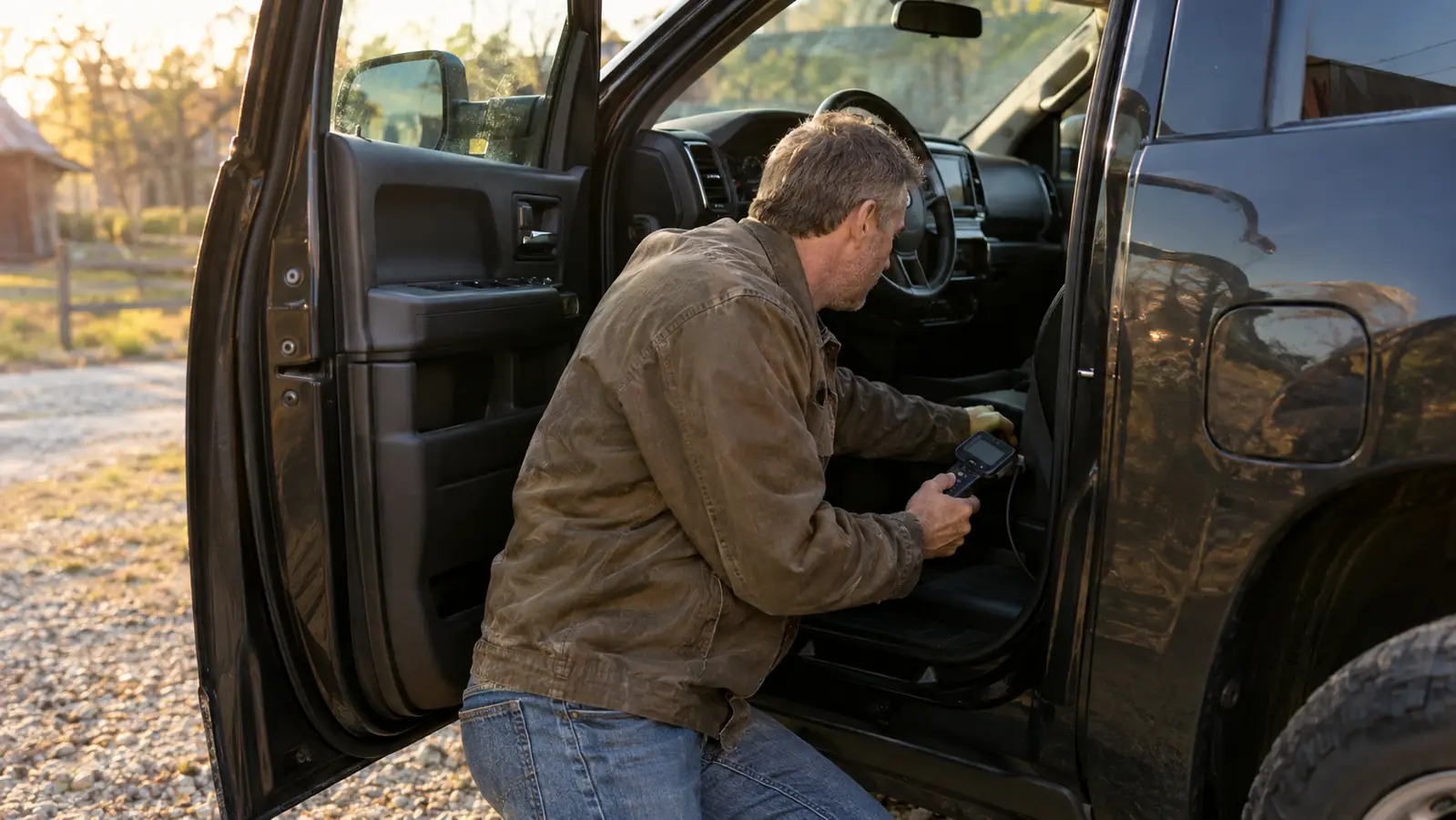
The check engine light came on in my daughter's 2008 Accord on a Tuesday afternoon, and for about ten seconds I had that feeling every driveway mechanic knows. The one where you wonder if this is a loose gas cap or a costly repair. Before I started keeping an ANCEL AD310 in the truck, that meant a trip to the parts store to borrow their scanner, or paying a shop just to tell me what the light meant. Neither one is a good use of an afternoon.
The good news is that reading and clearing a check engine code is one of the easiest jobs you can do on a modern car. You do not need a lift, specialty tools, or a shop manual. You need a scanner that talks to the car's computer, a few minutes, and a little patience. Here is the process I use on my 2014 F-150 and the Accord, step by step, the same way I would walk you through it in my garage.
Start With the Scanner I Keep in the Truck
The ANCEL AD310 is the code reader I grab first. It is one of the best-selling OBD2 scanners on the market and a tool Scotty Kilmer recommends. It plugs straight into the OBD2 port, draws its power from the car, and needs no batteries or charger. The 2.4 inch screen shows the code and a plain English description, and it covers 1996 and newer US cars plus 2000 and newer European and Asian vehicles, light trucks, and SUVs.
Amazon Check Today's Price on Amazon →Step 1: Find the OBD2 Port and Plug In
Every car sold in the US since 1996 has the same diagnostic port, and it is almost always under the dash on the driver's side. On my F-150 it sits just below the steering column, tucked behind a small access panel. On the Accord it is in the same general spot, right above the hood release. If you cannot find it, look for a trapezoid shaped connector with sixteen pins, which is the OBD2 plug. It is hard to mistake once you know what you are looking at.
The AD310 plugs directly into that port, and the included components are simple: the scanner, the user's manual, and nothing else to buy. It is a corded unit, so it draws its power from the car and there are no batteries to keep charged. The unit weighs 12 ounces and measures about 8.9 by 6.9 by 1.4 inches, with clearly labelled buttons and a 2.4 inch screen. Once it is seated in the port, you are ready for the next step. If the connector does not seat firmly, push until it clicks; a loose connection gives you a blank screen every time.
Do this with the engine off and the parking brake set. You are not starting the car, so it is not going anywhere, but setting the brake is a good habit. If the port is tucked up high under the dash and you have to reach, a small flashlight helps you see what you are doing. On most cars you can reach it from the driver's seat without getting out.
Step 2: Turn the Key to the On Position, but Do Not Start the Engine
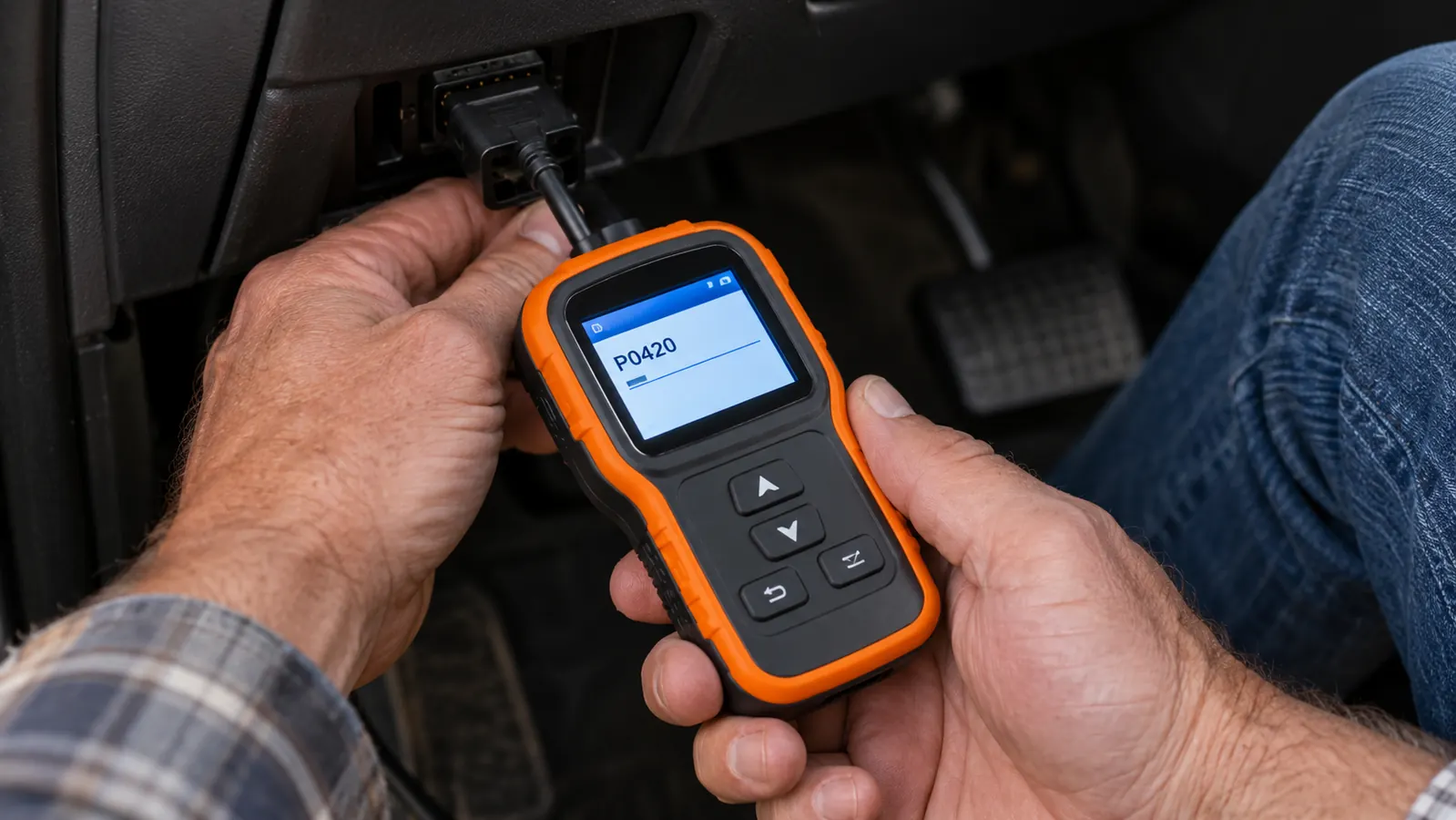
The scanner needs the car's computer to be awake, but the engine does not need to be running. Put the key in the ignition and turn it to the on position, the second detent, the one that lights up the dash. On the Accord that is one notch before the engine cranks. On the F-150 it is the same. You will see the dashboard lights come on, and the scanner screen should light up and start talking to the computer.
Give it a few seconds to link up. The AD310 is fast, but the car's computer still has to wake up and answer. You will know it is connected when the screen settles on a menu or shows a code. If the screen stays blank, check the connection at the port and make sure the key is in the on position. Nine times out of ten, that is the whole problem.
Depending on the car, the screen may show a menu with a few options, or it may go straight to a list of codes. The AD310 keeps things simple, and the buttons are clearly labelled, so you will not need to memorize anything. If you do get turned around, the included user's manual has the menu layout, which is why I keep it in the glovebox.
Step 3: Read the Code and Write It Down
Once the scanner links up, it will display any stored codes. A code looks like a letter followed by four numbers, P0301, P0420, P0171, that sort of thing. The letter tells you which system is complaining. P means powertrain, which covers the engine and transmission and is what you will see most often. B is body, C is chassis, and U is network communication. The first number after the letter tells you whether it is a generic code that applies to all cars or a manufacturer specific one.
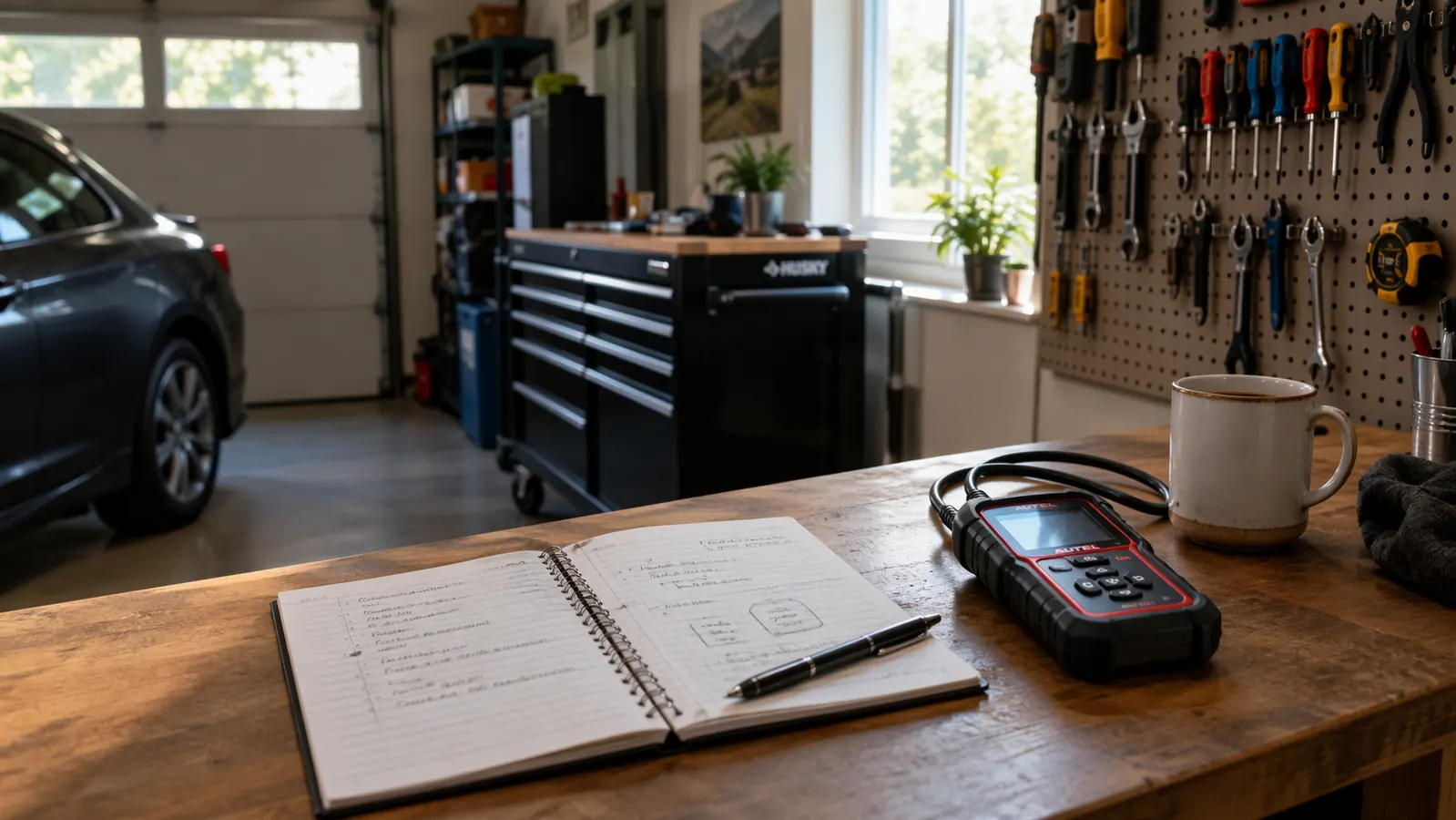
The ANCEL AD310 shows the code and a short description in plain English on its 128 by 64 pixel screen, which is plenty readable for this job. Write the code down before you do anything else, along with the date and the mileage if you can. I keep a spiral notebook in the garage for exactly this. You want the code recorded before you clear it, because once it is gone, it is gone, and you will wish you had the number when you are standing at the parts counter.
Do not clear the code yet. I know it is tempting to clear it right then and watch the light go out, but the code is the clue you need to decide what comes next. Clearing it now just means you lose the information. Read it, write it down, and move on to figuring out what it means.
Step 4: Look Up the Code and Decide What to Fix
Now you have a code, and the code points you at the system involved. P0420, for example, means the catalytic converter efficiency is below threshold on bank one. P0301 means cylinder one has a misfire. P0171 means the engine is running lean on bank one. The description on the scanner gets you in the neighborhood, and a quick search with your make and model gets you the rest of the way. There are plenty of free lookup sites and forums where someone has already had the same code on the same car.
Here is where the scanner earns its keep. On my daughter's Accord, a P0420 could mean a failing catalytic converter, which is a big job, or a lazy downstream oxygen sensor, which is a couple of hours and a moderate part. The code alone does not tell you which. But it tells you where to start looking, and it keeps you from paying a shop to run the same test. For a basic reader like the ANCEL AD310, you get the code and the description, which is usually enough to point you at the right part or the right test.
Sometimes the answer is simpler than you think. A loose gas cap sets a code on a lot of cars, and the fix is a quarter turn until it clicks. If the code points to something you are not comfortable with, like anything involving the transmission or airbags, that is the point where I call a shop. The scanner is a diagnostic tool, not a repair manual. It tells you what is wrong, not whether you should attempt the job.
A P0301 on the Accord would send me to the spark plugs and ignition coils first, because those are common wear items and a reasonable place to start. If the misfire moved to a different cylinder after I swapped a coil, I would know the coil was the problem. That kind of logic is how a code becomes a repair plan instead of a guess.
Step 5: Clear the Code and Verify the Fix
Once you have made the repair, or confirmed that the cause was something simple like a loose cap, you can clear the code. On the ANCEL AD310, use the clearly labelled buttons to navigate to the erase or clear function, confirm your choice, and the scanner will reset the computer's memory. The check engine light should go out. If it stays on, the code was still active, which usually means the fix has not taken effect yet. That is the whole process, and it takes less than a minute.
Clearing the code does not fix the problem. It only resets the light. If the underlying issue is still there, the code will come back, sometimes within the same drive. So after you clear it, drive the car through a normal drive cycle, a mix of city and highway driving with a few stops, and see if the light returns. If it stays off for a few days, you fixed it. If it comes back, you have more work to do, and now you have the same code written down to guide you.
One honest warning before you clear anything. If your state does emissions testing, a recently cleared code can be a red flag on the test, because the computer's readiness monitors need time to reset. Do not clear a code the morning of a smog check and expect a clean pass. Fix the problem, clear the code, and drive it long enough that the system has time to confirm everything is working.
What Else Helps
A scanner is the main tool, but a few cheap things make the job easier. Keep the user's manual that comes with the ANCEL AD310 in the glovebox, because it has a quick reference for the buttons and the menu. Keep a notebook and a pen in the garage to log codes, dates, and mileage. And keep your phone handy for looking up codes, because the scanner gives you the number and the short description, and the internet gives you the full story for your exact car.
The AD310 covers 1996 and newer US vehicles and 2000 and newer European and Asian cars, light trucks, and SUVs, which covers both vehicles in my driveway and just about anything a neighbor is likely to pull up with. It is not a professional scan tool. Do not expect live sensor data or bidirectional controls, and I would not pretend otherwise. That honesty matters, because the last thing you want is to buy a tool expecting shop level features and find out later it cannot do them. For reading and clearing codes, which is what most driveway repairs actually need, it does the job without fanfare.
A few codes are worth knowing by heart. P0300 is a random misfire, P0420 is catalyst efficiency below threshold, P0171 is a lean condition, and P0455 is a large evaporative system leak, which is often just the gas cap. When you see one of those, you already have a head start on the repair.
A loose gas cap set off the check engine light on my F-150 at 190,000 miles. The AD310 read the code in under a minute, I tightened the cap, cleared it, and it never came back.
Reading and clearing codes is one of those skills that looks intimidating until you have done it once. The first time you plug in, read a code, and know exactly what it means before you call anyone, you will wonder why you ever paid someone else to do it. It takes longer to read this article than it does to run the scanner. Keep the AD310 in the truck, keep a notebook in the garage, and the next time that light comes on, it will be a ten minute job instead of a day of wondering.
Keep a Code Reader in Your Garage
The ANCEL AD310 has earned its keep in my garage a hundred times over. If you work on your own cars, or you just want to know what that light means before you call a shop, this is the tool to have on hand.
Amazon Check Today's Price on Amazon →