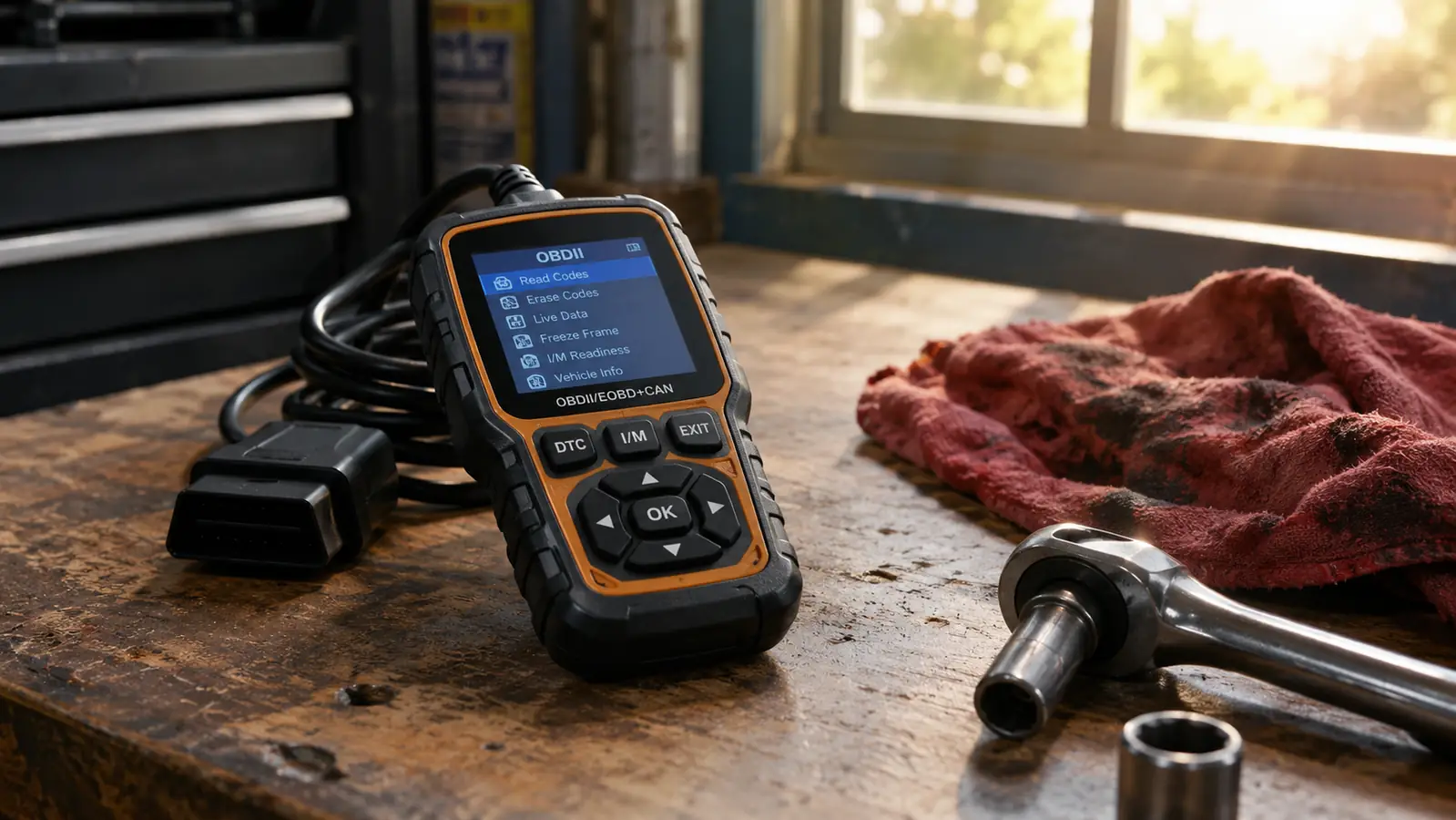
If you just want the code and the fix, the ANCEL AD310 gets you there without a phone, an app, or a subscription. The BlueDriver is a Bluetooth dongle that puts the same information on your phone screen, but it costs more, needs an app, and only works when your phone cooperates. I have used both in my driveway over the past year, on my 2014 Ford F-150 and on my daughter's 2008 Honda Accord. I am not a professional mechanic, just a guy who has wrenched on his own cars for over 30 years, and I would rather spend a Saturday in my garage than hand the truck to a shop. For most DIY home mechanics, the ANCEL is the one I would buy again.
Here is the short answer: the AD310 is a corded, self-contained scanner that plugs straight into the OBD2 port and shows the code on its own 2.4 inch screen. The BlueDriver does the same job through a phone app. The AD310 is simpler, cheaper, and never leaves you staring at a dead phone. The BlueDriver wins if you want live data graphs and the ability to email a report without writing it down. I bought the AD310 first, after a former coworker from the parts counter talked about using one on his work truck, and I picked up the BlueDriver later to see if the phone experience was worth the extra money. I kept both for a year, and this is what I learned.
| ANCEL AD310 | BlueDriver | |
|---|---|---|
| Price | A fraction of the dongle's cost, and no subscription to worry about | Costs roughly twice as much, with no subscription either |
| How it connects | Corded, plugs into the OBD2 port, nothing to pair | Bluetooth, requires app setup and phone pairing |
| Screen | Built-in 2.4 inch screen, readable in daylight | No screen of its own, everything runs on your phone |
| Phone needed | No phone needed at all, works anywhere the car is | Requires a smartphone and the app installed |
| Live data | Shows codes and basic data on its own screen | Streams live sensor data in the app |
| Reports | You read the code and look it up yourself | App can email a report to you or a shop |
| Code coverage | Reads and clears standard OBD2 codes | Reads and clears standard OBD2 codes as well |
| Best for | DIY home mechanics who want a dependable tool | Tinkerers who want data on their phone |
Where ANCEL Wins
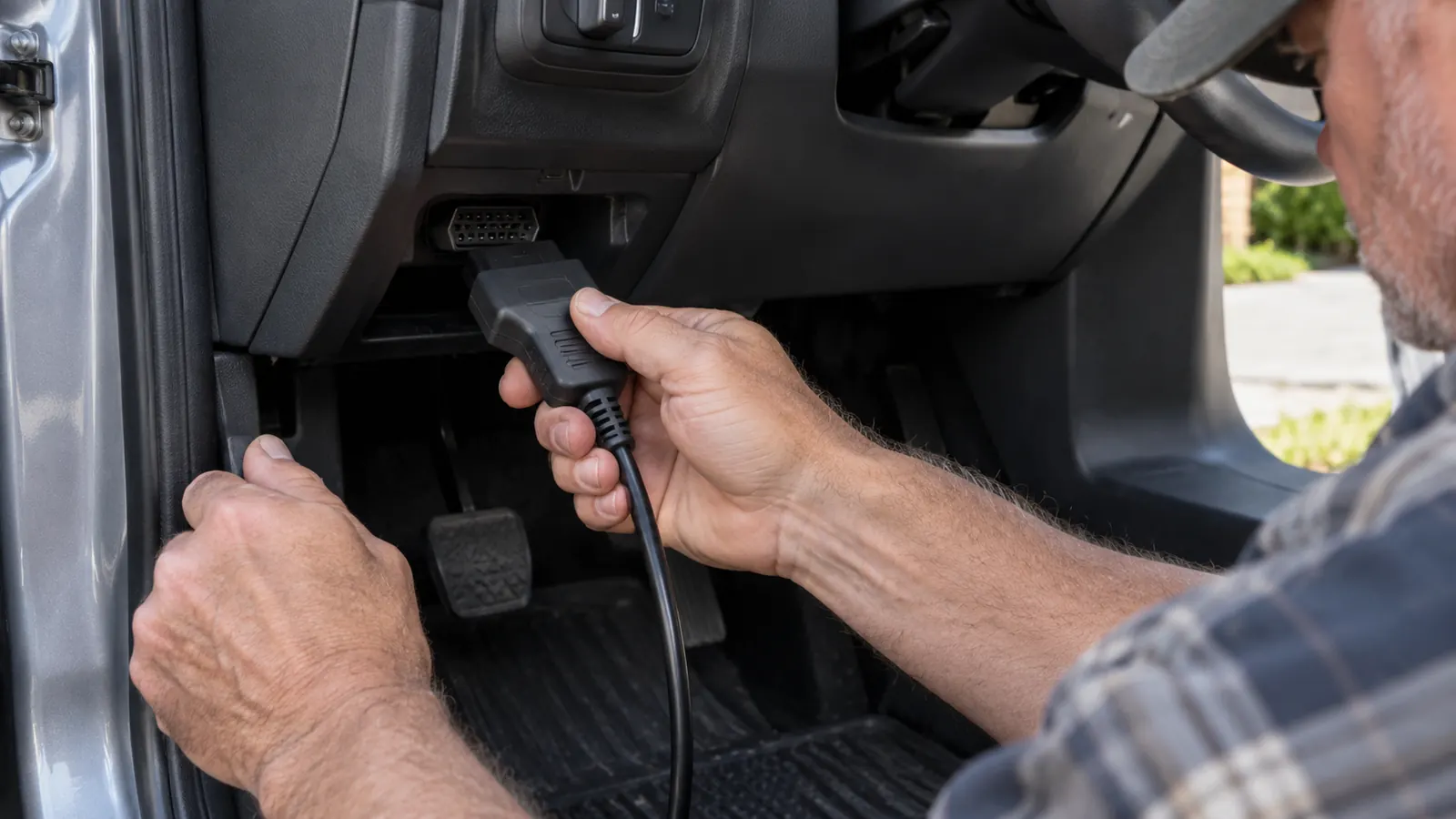
The ANCEL AD310 wins on the three things that matter most when you are lying on your back with a check engine light staring at you: simplicity, reliability, and price. There is nothing to pair, nothing to charge, and nothing to update. You plug the cord into the port under the dash, press a button, and the code appears on the 2.4 inch screen. That is the whole job, and it does it every time.
Take the morning the check engine light came on in my F-150 last fall. I was heading out to run errands, and the light popped on right as I backed out of the driveway. I pulled back in, grabbed the AD310 from the top drawer of my tool chest, and had the code on the screen before the truck finished idling. It was P0420, which told me the catalytic converter efficiency was reading low. I cleared it, drove the week, and when it came back I knew it was a real issue and not a loose gas cap. That is the whole value of a scanner in one story: it turned a vague worry into a specific number I could look up.
The second story is the one I tell people who ask if they really need a scanner. My daughter's 2008 Honda Accord threw a check engine light a few days before a road trip. She was ready to take it to a shop, which would have meant a diagnostic fee and a day without the car. I had her bring it over, plugged in the AD310, and got a P0456, which is a small evaporative emissions leak. I checked the gas cap, found it was not clicking shut, tightened it, cleared the code, and the light stayed off for the whole trip. The scanner cost less than the diagnostic fee would have, and it has paid for itself many times over.
The AD310 is also the easiest tool to hand to someone who does not want to learn a new app. The buttons are clearly labelled and the screen is large enough to read without squinting. The whole unit weighs about 12 ounces and measures 8.9 by 6.9 by 1.4 inches, so it lives easily in the door pocket of the truck. The cord reaches from the port under the dash to the driver's seat without any trouble, which matters when you are alone and need to read the screen while you turn the key. It runs on the car's own power through the cord, so there is no charger to keep track of and no battery to find dead at the wrong moment. The included components are the scanner and a user's manual, and that is genuinely all you need.
It is not a fancy tool. The screen is 128 by 64 pixels, which sounds small until you are actually reading a code on it, and the resolution is fine for what it does. It covers 1996 and newer US-based cars, 2000 and newer EU-based and Asian cars, light trucks, and SUVs, which means it will read just about anything parked in your driveway or mine. I have had mine for the better part of a year and it still lives in the same door pocket, ready when I need it. For a driveway mechanic, a tool that cannot run out of battery and cannot forget its pairing is worth more than a tool with a prettier screen.
The other thing I appreciate is that the AD310 does not try to sell you anything after you buy it. There is no subscription tier, no premium features locked behind a login, no account to create. You pay once and it works for as long as the car has an OBD2 port. That matters to me more than it used to, because I have watched too many tools turn into monthly fees.
Where BlueDriver Wins
The BlueDriver wins when you want your phone to do the heavy lifting. The app shows live sensor data, lets you watch readings change as the engine runs, and can email a report if you need to send something to a shop or a friend. If you like seeing everything on a big screen instead of a 2.4 inch one, the dongle has the edge.
I will give you a concrete example. One cold morning I wanted to watch the coolant temperature climb on the F-150 as it warmed up, because I suspected the thermostat was sticking. With the BlueDriver, I sat in the driver's seat with the phone on the dash and watched the temp reading move in real time. It was genuinely useful, and it is the kind of thing a corded scanner with a 128 by 64 screen simply cannot show you in the same way. If you are chasing an intermittent sensor or trying to diagnose something that only happens when the engine is warm, live data is worth the extra money.
The BlueDriver also wins if you already live in your phone's ecosystem and do not mind the setup. Pairing takes a few minutes, and once it is paired it is easy to pull up codes and clear them from the driver's seat. Having the codes on the phone means you can screenshot them or send them to yourself, which is handy if you are tracking a code that comes and goes. And if you need to send a report to a shop, the app can email it, which saves you from writing a code on a scrap of paper and hoping you copy it down right.
But that convenience only works when the app behaves, and I have had mornings where the phone would not connect and I just wanted the code. One Saturday I went out to clear a code on the Accord before a trip, and the dongle would not pair no matter what I did. I rebooted the phone, restarted the app, and finally gave up and walked back to the house for the AD310. It was a five-minute job after that. On those mornings, the corded scanner wins, and that is the trade you are making: a bigger screen and live graphs when it works, versus a tool that works on the first try every single time.
I want to be fair to the BlueDriver here. It is a good tool, and the people who love it tend to be the same people who track fuel trims and watch sensor data for fun. If that sounds like you, the dongle is worth a look. But the reason I keep the ANCEL in the truck is that my job is fixing the car, not watching the data.
The dongle is small, which is good for the glove box and bad for losing it. It lives in the OBD2 port while you work, which means it is easy to leave in the car and easy to knock when you are under the dash. The corded scanner sits on the seat next to you, out of the way.
A tool that cannot run out of battery and cannot forget its pairing is worth more than a tool with a prettier screen.
Want the code without the phone?
The ANCEL AD310 is the corded scanner I keep in my tool chest. It reads the code, shows it on its own screen, and never needs an app or a pairing ritual. It is the tool I reach for first.
Amazon Check Today's Price on Amazon →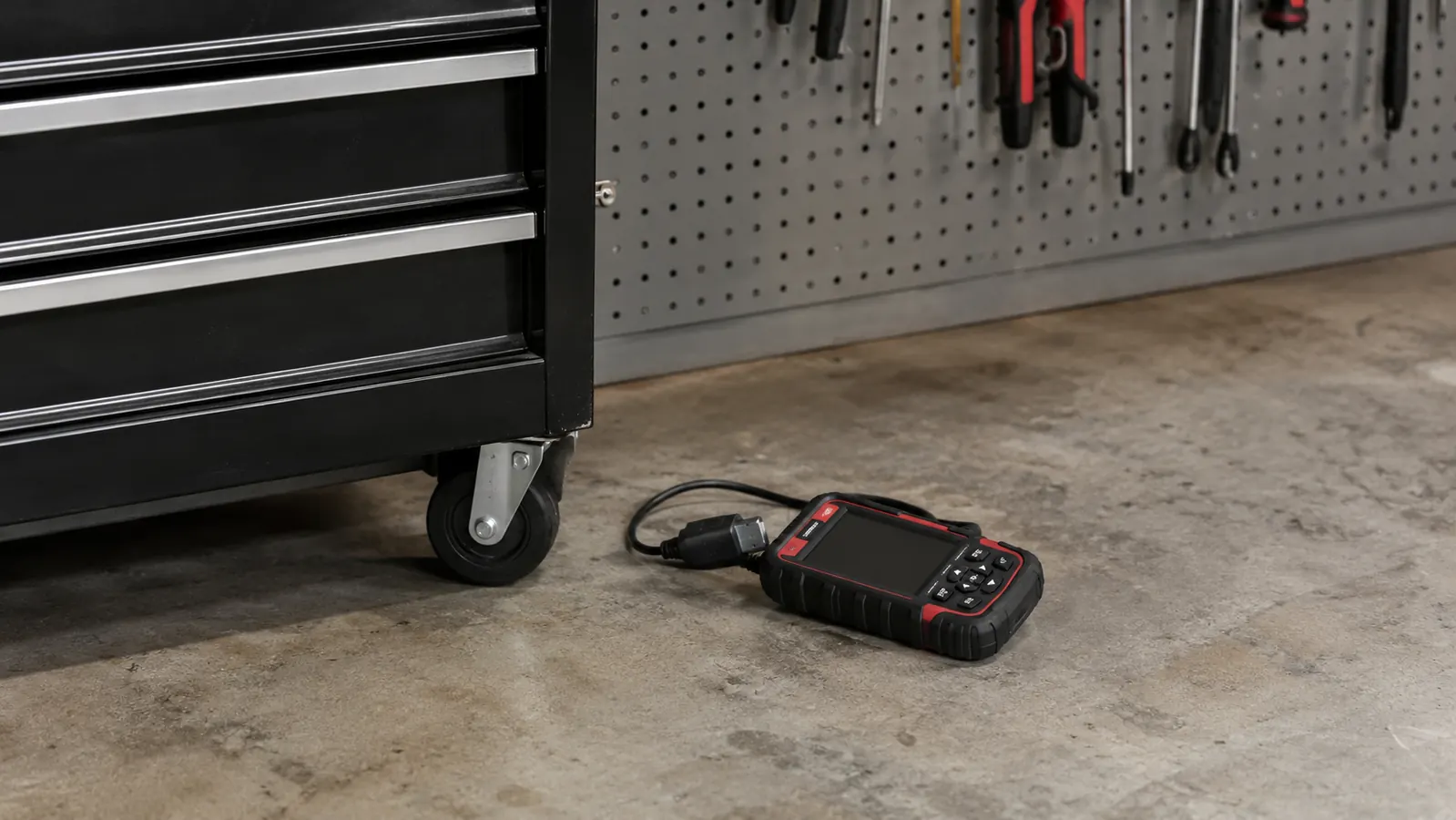
Who Should Buy Which
Buy the ANCEL AD310 if you want a tool that works every time, costs less, and does not depend on your phone. It is the right choice for a weekend mechanic who wants to read a code, look it up, and get back to the job. It is also the right choice if you are buying a scanner for someone who is not comfortable fiddling with apps. My rule of thumb is simple: if the person you are buying for has ever asked you to 'just look at the car,' get them the corded scanner.
Buy the BlueDriver if you want live data graphs on your phone and you are willing to pay more and deal with pairing. It is a good tool for someone who wants to watch sensor readings while a friend revs the engine, or who needs to email a report to a shop. It is also a reasonable choice if you already own a Bluetooth adapter for something else and you like having everything in one app.
For everyone else, the ANCEL is the simpler, cheaper, more dependable buy. The AD310 has been one of the best-selling OBD2 scanners on the market for years, and it is recommended by Scotty Kilmer, which is how a lot of driveway mechanics first hear about it. It reads 1996 and newer US-based cars, 2000 and newer EU-based and Asian cars, light trucks, and SUVs, so it covers everything we drive without a second thought. I keep mine in the door pocket of the truck, and I reach for it first every time. If you are on the fence, ask yourself one question: when the check engine light comes on, do you want to reach for your phone or reach for a tool?
Is there a case for owning both? Sure, if you do enough diagnostics that live data would save you real time. But most households need one scanner, and the corded one is the one that will actually be in the truck when the light comes on.
Keep it simple. Keep the ANCEL.
The AD310 is the scanner I reach for first. It reads the code, shows it on its own screen, and gets you back to the job without a phone in the way.
Amazon Check Today's Price on Amazon →