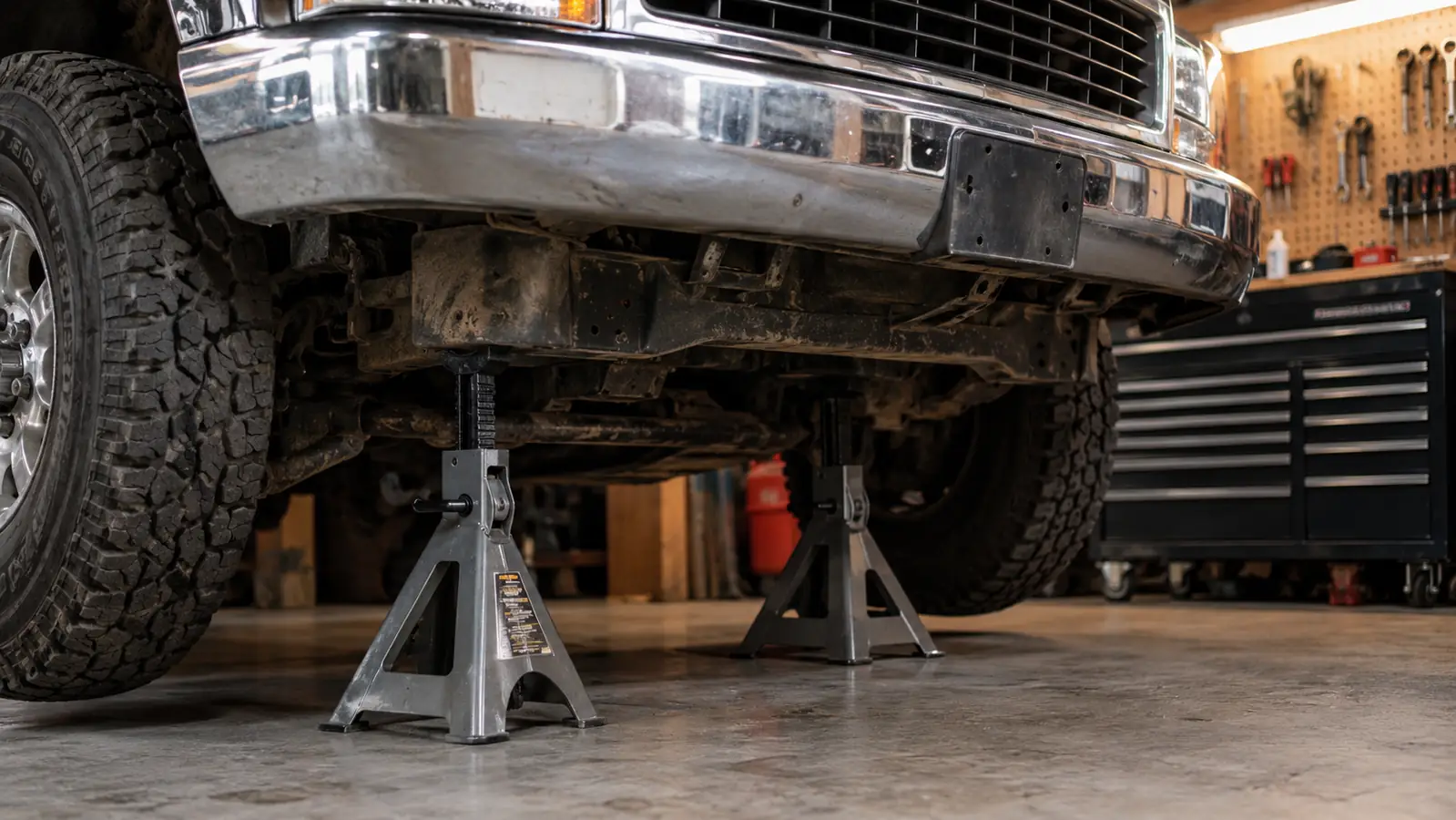
Somewhere in your garage there is a floor jack, and it is not enough. I say that as a guy who has wrenched on his own cars for over 30 years and has the skinned knuckles to prove it. A floor jack lifts a car. It was never meant to hold one. The BIG RED T43202 steel jack stands that live in my garage are what actually hold the car, and once I started using a pair of them on every job, I stopped worrying about what was above me.
Here is the rule I teach anyone who asks: the jack is for lifting, the stands are for holding. If you only own a jack, you are one slow leak away from learning the difference the hard way. I have watched a hydraulic jack bleed down in the time it took to swap a rotor. These ten reasons are why I will not put a wheel back on a car that was supported by a jack alone.
The pair I trust under my truck and my daughter's Accord
BIG RED T43202 steel jack stands: 3-ton (6,000 lb) capacity, sawtooth ratchet bar, and height from 11-1/4 to 16-3/4 inches. Check today's price on Amazon.
Amazon Check Today's Price on Amazon →A jack lifts. A stand holds. Those are two different jobs.
The floor jack is a machine with moving parts, fluid, and seals. It is built to raise a vehicle a few inches and then get out of the way. A jack stand is a static steel post with one job: stay put. When I set a BIG RED stand under the frame and hear the ratchet bar click into place, the car is no longer depending on a machine. It is resting on steel.
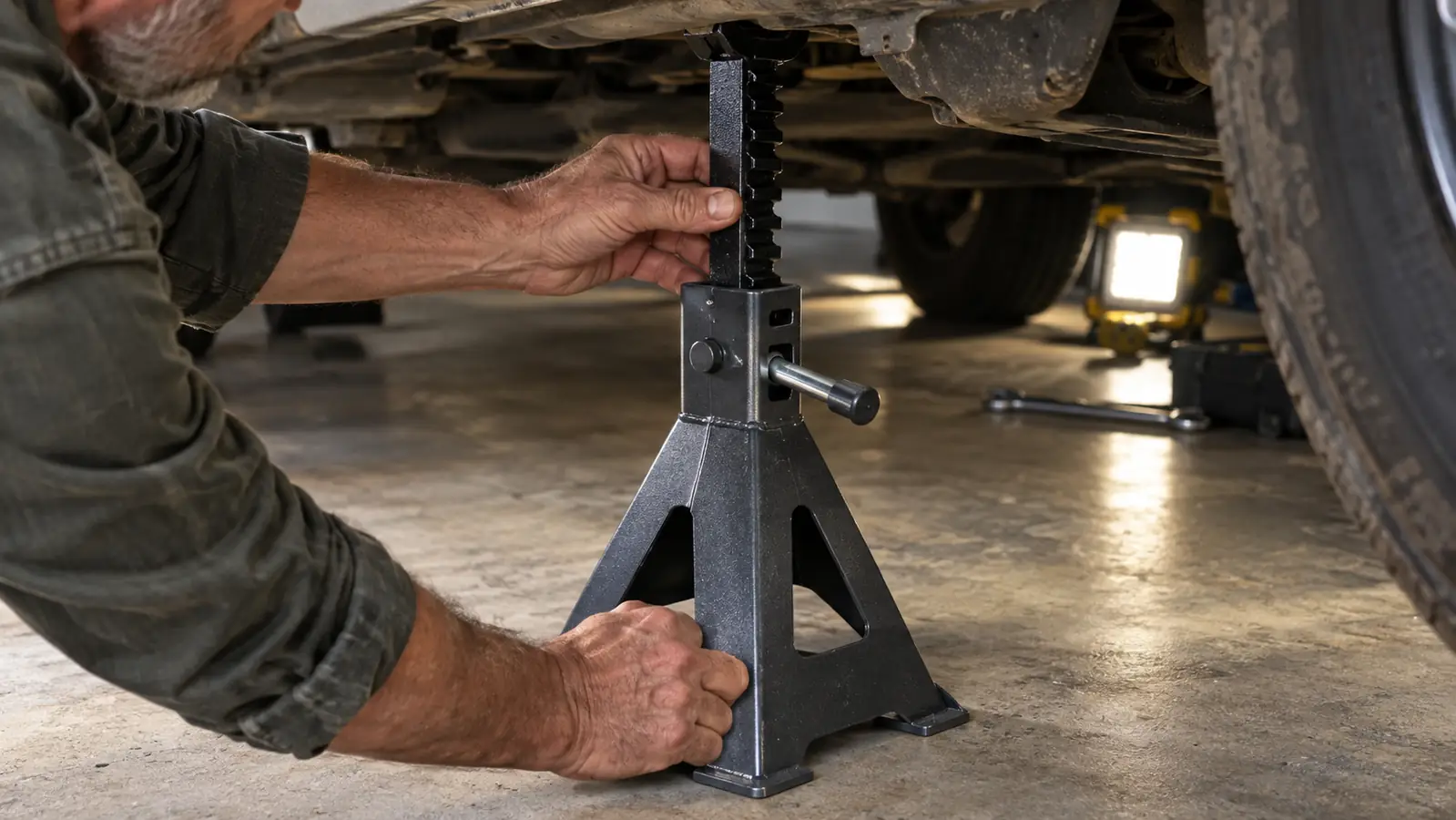
Hydraulic jacks fail quietly. Steel stands do not.
A hydraulic jack bleeds down through a seal you cannot see and a fluid level you cannot check without tearing the thing apart. It does not fail with a bang. It fails an inch at a time while you are reaching for a socket. A stand has no fluid, no seal, and no pressure to lose. The sawtooth ratchet bar locks into a notch and stays there until you move it.
The ratchet bar locks at your exact height.
The T43202 uses a multi-position ratchet bar with a sawtooth design, which sounds like marketing until you use it. You lift the car, slide the stand underneath, and ratchet it up until it meets the frame. Each click is a locked position. No pins to line up and no cotter keys to drop into the engine bay while you are holding a car up with one hand.
One pair covers a low car and a tall truck.
These stands adjust from 11-1/4 inches up to 16-3/4 inches. That range covers my daughter's Accord, which sits low enough that I have to be careful with a floor jack under the pinch welds, and my F-150, which rides higher on its frame. I have never owned a vehicle that did not fit between those two numbers, and I have owned some odd ones over the years. One pair does the whole driveway, and that is the reason a single set earns its spot in the garage.
The wide pyramid foot base stays put on concrete.
The base is a wide pyramid foot, and it matters more than people think. A narrow post can rock or dig into a seam in the concrete. A wide foot spreads the load and sits flat. On my garage floor the stands do not walk, they do not tip, and they do not make me flinch when I bump them with a knee while reaching for a breaker bar.
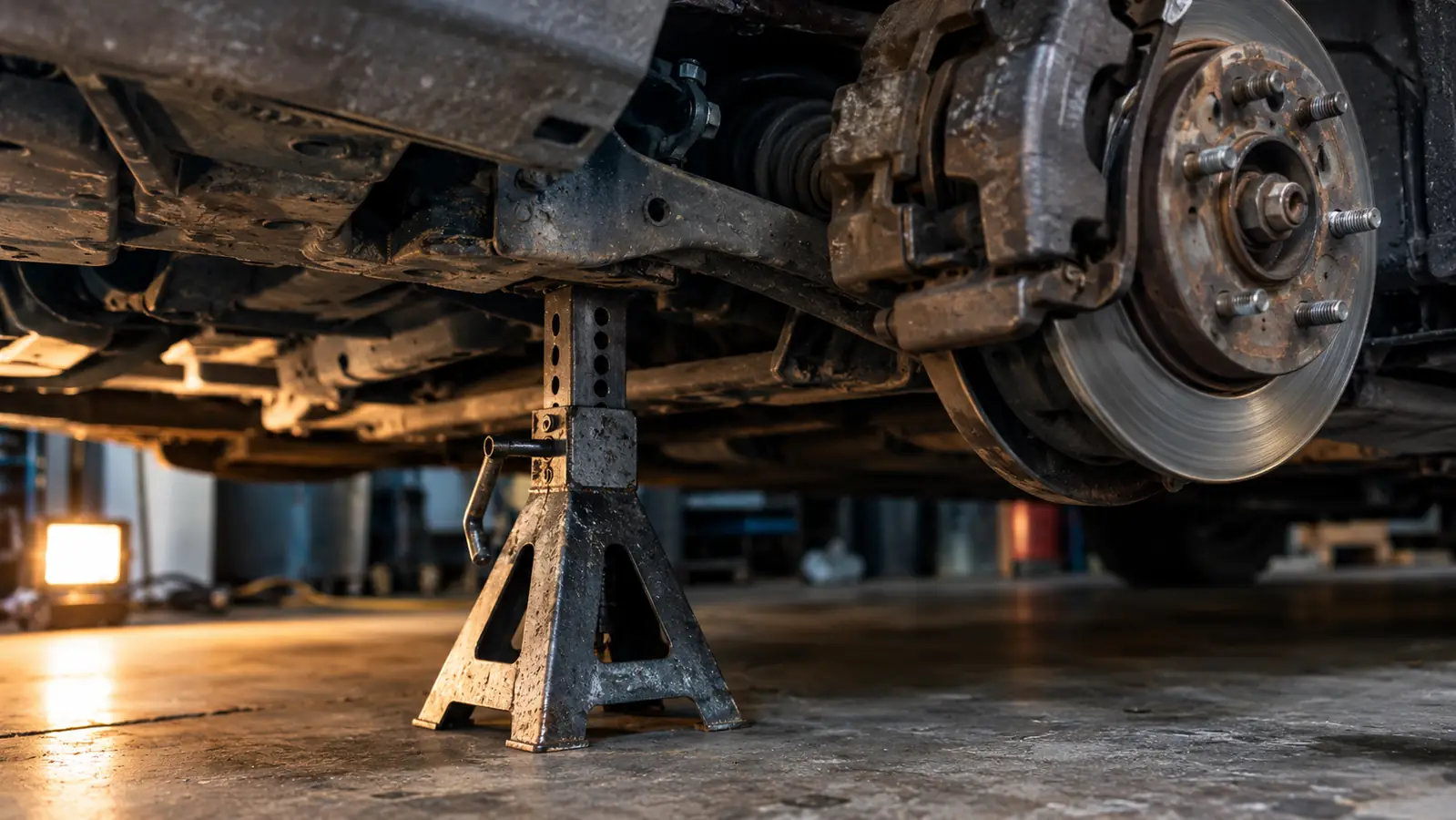
Two stands make a triangle. A jack alone is a single point.
One jack under the frame is one point of contact holding up thousands of pounds. Put two stands under the front cradle points and the car rests on three points: two stands and the rear wheels. A triangle does not fold. For brake jobs with both front wheels off the ground, this is the difference between working calmly and working scared.
Stands free up your jack for the next corner.
When the car is on stands, the jack is free to move. I can lift the front, set the stands, then walk the jack to the rear axle and do the same. Try that with a jack alone and you are juggling one lifting point across four corners. Stands let you work in stages, and working in stages is how a driveway job stays safe.
Steel does not get tired at 2 a.m.
Some jobs run long. A battery swap turns into a wiring chase, a brake job turns into a seized caliper bracket, and suddenly the car has been in the air for three hours while you make a second trip to the parts store. A hydraulic jack parked under a car all evening is a gamble, because seals do not care that you are almost done. Steel stands do not get tired, do not leak down, and do not care how long the job takes.
The load rating leaves room for the real world.
The T43202 pair is rated for 3 tons, 6,000 lb. My F-150 is a full-size truck, heavy enough that I check load ratings twice before I get under anything. The stands do not flex, do not groan, and do not make me do math while I am on my back. I would rather have a stand rated for more than I need than one that sits exactly at the limit, because exact ratings assume a clean floor, a centered load, and no mistakes. That margin is the whole point.
They will outlast the car they are holding up.
Steel stands with no moving parts to wear out and no fluid to change are a buy-it-once tool. BIG RED backs these with a limited one-year warranty, but the honest truth is the warranty will expire long before the stands do. Mine live on the garage floor, get kicked around between jobs, and still ratchet up smooth and lock tight like the day they came out of the box. I cannot say that about any hydraulic jack I have owned.
What I'd Skip
Jack stands are not for everyone, and pretending otherwise is how good tools end up in a drawer. Skip them if you only ever swap a spare tire at the roadside; a factory jack and a level spot are enough for that. Skip them if you work on gravel or soft ground, because a wide foot base still needs solid footing to mean anything. And if you are tempted to use one stand as a work platform, or stack one stand on another to gain height, skip the whole idea and take the car to a shop. I send transmission work and anything with airbags to a professional, and you should too. A stand is a support, not a ladder and not a bench.
A hydraulic jack bleeds down an inch at a time. A steel stand with a locked ratchet bar does not move until you move it.
Put a pair under your car before you need them
BIG RED T43202 steel jack stands are the first thing I reach for on any job that puts me under a vehicle. Check today's price on Amazon and keep a pair in the garage before you need them, not after.
Amazon Check Today's Price on Amazon →