
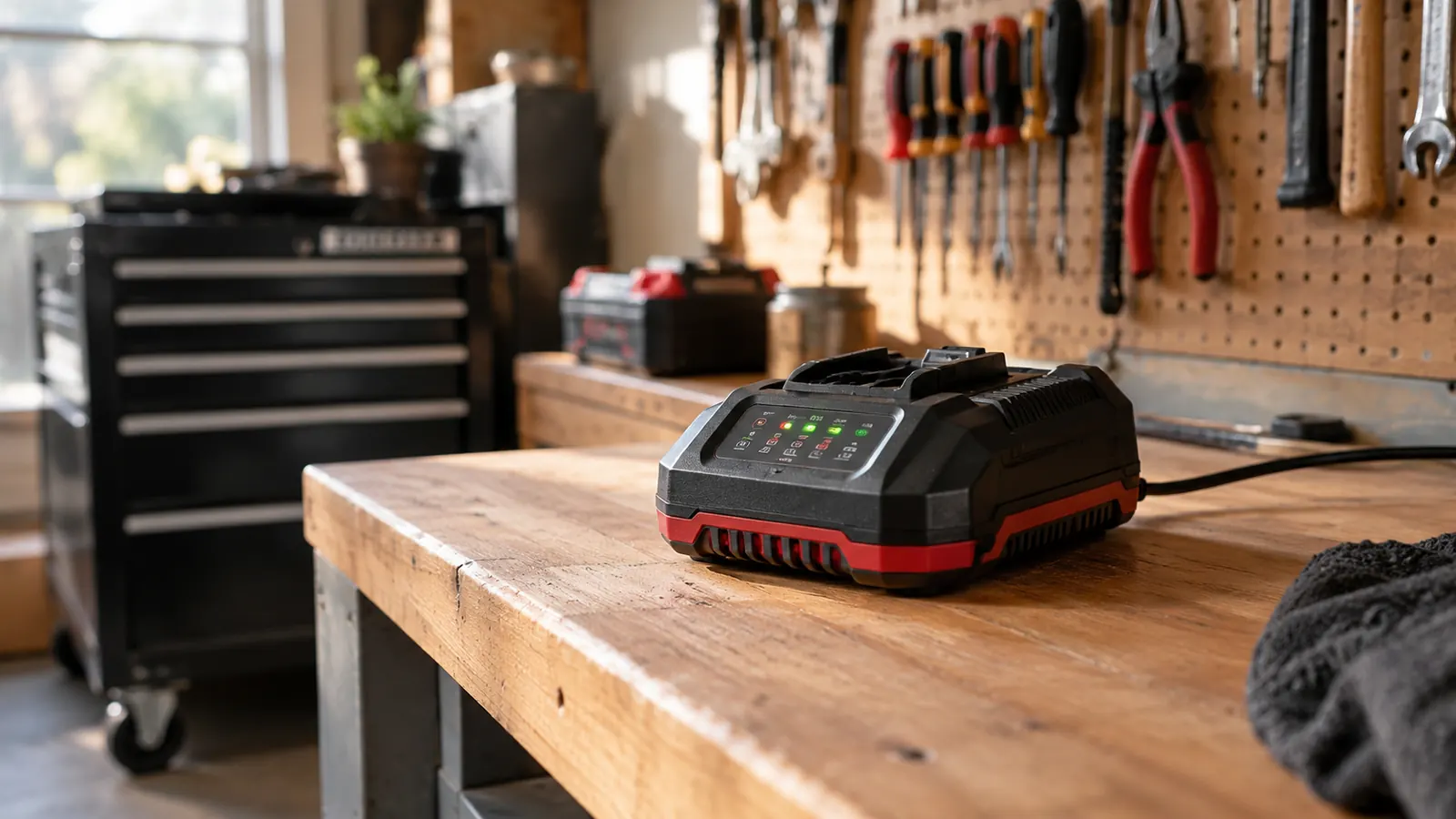
I will tell you the same thing I told my neighbor when he caught me hooking the little NOCO box to the Accord for the third night in a row: it is not fast, and that is the point. Most people buy their first battery charger expecting it to behave like a jump start. This one behaves like a slow drip on a thirsty battery. It took me a while to appreciate that. I spent thirty years behind a parts counter and another twenty wrenching on my own stuff, and I like a tool that finishes the job before supper. But a 1 amp charger is not about finishing before supper. It is about finishing right.
Here is what nobody tells you before you buy one of these. A battery that sits dead for two weeks is a battery that is slowly dying. The plates sulfate, the charge drops, and by the time you get around to jumping it, you are asking a weak battery to do a job it no longer can. The NOCO Genius1 exists to stop that before it starts. It is a charger, a trickle charger and a maintainer in one small box, and it will happily sit on your bench for months doing nothing at all. That is not a flaw. That is the job.
The Quick Verdict
The slowest tool in my garage is also one of the most useful. If you need a battery kept alive instead of revived in a hurry, this is the one.
Amazon Check Today's Price →Put a 1 amp charger on every battery that sits, and watch how long they last.
The NOCO Genius1 charges, maintains and watches the temperature while it does it. It is the quietest worker in my garage.
Amazon Check Today's Price on Amazon →How I've Used It
My setup is not fancy. The two-car garage has the 2008 Accord in it, the one I keep running for my daughter, and the F-150 lives outside under a carport. The truck gets driven most days, but not every day, and a truck that sits for four or five days in an Arkansas July loses more charge than you would think. So the NOCO spends most of its time on the Accord, because that is the car that cannot fail to start. When it is not on the Accord, it sits on the shelf above the pegboard with the clamps wrapped around it.
I have used it three ways. First, as a maintainer, with the eyelet terminals bolted to the battery posts so I can connect the charger without tools. Second, as a charger, when the truck sat through a cold snap and the crank got slow. Third, as a bench charger for the mower battery every spring, because a mower battery that ends the winter dead is a mower battery that ends the spring replaced. The compatible devices list on the box reads like a list of everything I own with an engine.
The 10 hour charge time in the specs is honest. A 1 amp charger puts roughly 1 amp in per hour, so a battery that is deeply discharged takes most of a day to come back. I learned to plan around that. Hook it up before supper, check it in the morning. That rhythm is the whole trick, and it is the part the marketing never tells you. The first time I used it, I expected more drama. There was none.
One thing I did not expect: the eyelet terminals stay on the battery full time, and I run the cable out through the hood gap so the hood closes clean. That sounds like a detail, but it is the difference between a charger you use and a charger you dig out of a drawer. The less friction there is between you and the hookup, the more often you will do it.
What Nobody Tells You About a 1 Amp Charger
The first thing nobody tells you is that the smart part matters more than the 1 amp part. This thing reads the battery. It is designed for 6 volt and 12 volt lead-acid batteries across AGM, gel, SLA and VRLA chemistries, and it will also handle lithium-ion LiFePO4 packs. You do not need to know what those letters mean. The charger does. You just connect it and let it sort out what it is looking at.
The second thing nobody tells you is that there is an integrated thermal sensor inside that adjusts the charge based on ambient temperature. That sounds like marketing language until you live with it. A battery charges differently at 95 degrees than it does at 30. The NOCO watches the temperature and changes how it charges so it does not cook a battery in July or undercharge it in January. In a place like Jonesboro, where the garage swings from one extreme to the other, that is not a gimmick. It is the difference between a battery that lasts three years and one that lasts five. That is not a feature you can see or touch. It is a feature you feel in the spring, when the battery still turns over like it did the year before.
The third thing nobody tells you is that you will never use most of what this charger can do, and that is fine. The company says it is 35% smaller than its older units and delivers over 35% more power, which is the kind of claim I normally roll my eyes at. But the size is real. It weighs 15.2 ounces and measures 4.02 inches deep, 3.43 inches wide and 6.73 inches tall. It sits on the fender without sliding off. It fits in the glove box if you want it to. That small size is what makes you actually use it, because it is never in the way. I keep mine on the shelf above the pegboard, and I forget it is there until I need it.
The fourth thing, and the one that cost me the most to learn, is that a maintainer is not a jump starter. When the truck battery was truly dead, not low but dead, the NOCO was not the tool I reached for. I reached for jumper cables and a neighbor with a running car. That is not a failure of this charger. It is a failure of my expectations, and it took me one long afternoon to accept the difference. A 1 amp charger does not rescue you. It prevents the need for rescue.
It is not fast, and that is the point. A 1 amp charger is not about finishing before supper. It is about finishing right.
The Small Stuff That Matters
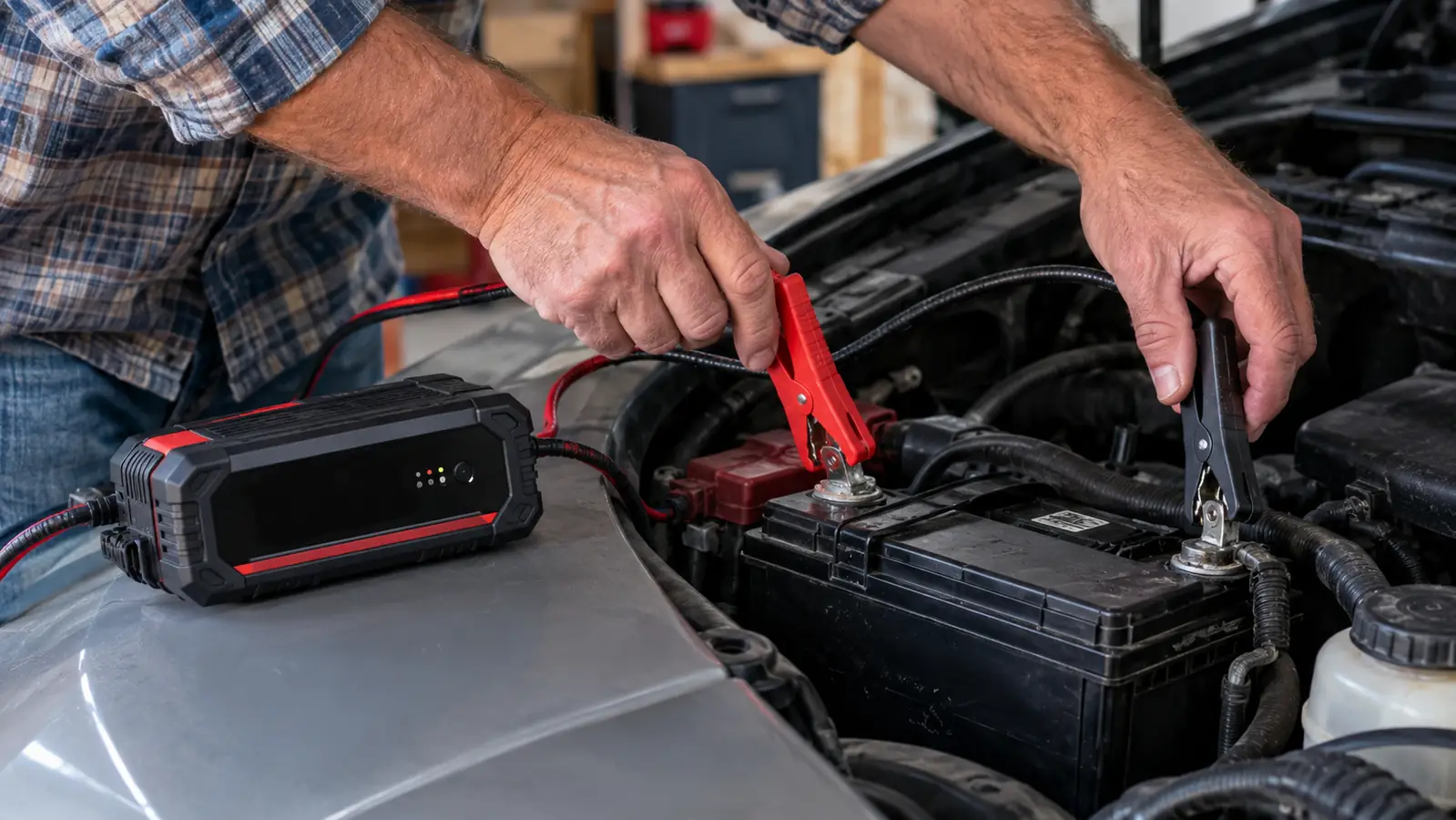
The clamps are the part people overlook, and they are the part I would buy this charger for again. The box comes with battery clamps and eyelet terminals. The eyelets are the important one. You bolt them to the battery once, route the cable out from under the hood, and from then on connecting the charger is a ten second job. No tools, no skinned knuckles, no wrestling with a clamp that does not want to seat. For a man my age who has spent too many evenings with a flashlight and a bad angle, that is a real feature.
The clamps themselves grab well and stay put. I have knocked the cable twice while reaching across the engine bay, and the clamp did not come off. That matters more than it should, because a charger that falls off in the night is a battery that starts the morning dead anyway. The cable is not long, so you do have to think about where the charger sits, but once you find a spot it does not move. I have also used the clamps on a battery that was still in the car, which is how most people will use them, and they grab the post cleanly every time.
It is UL listed, which a lot of people skip past, and it meets CEC and FCC standards. For something that plugs into a 120 volt wall outlet and sits unattended for weeks, that paperwork is not paperwork. It is the difference between a device that handles a fault gracefully and one that does not. The 3 year limited warranty is the company betting on the same thing.
What It Does Well
For keeping a battery alive, I have not found anything easier. The Accord sits for days at a time, and the battery has not once been slow to crank since I put the eyelets on. That is the quiet win. You do not notice a maintainer working. You notice when you stop using one, because that is when the battery dies in the middle of a Tuesday and you are late for work.
It is also forgiving of my habits. I have left it connected for three weeks straight without thinking about it. I have connected it in the dark. I have set it on the fender, on the battery hold-down, on a stack of shop rags. It does not care. It sits there and does its job, and the thermal sensor keeps it honest through the temperature swings.
How It Handles the Seasons
Arkansas does not do subtle seasons. The garage hits the high 90s in August and dips below freezing in January, and a battery feels both. I have watched the NOCO work through both extremes. In the summer, it slows itself down on the hottest days, because a hot battery does not need the same push as a cold one. In the winter, it holds the charge steady so the truck does not groan on the first cold morning. I cannot show you a graph of it. I can show you a battery that has not let me down in a year and a half.
The 10 hour charge time also means you learn to think in seasons, not minutes. I put the mower battery on the charger in March, the week before the first cut. I put the Accord on it whenever the car will sit for more than a couple of days. The truck gets a session after any long stretch of not driving. It becomes a rhythm, like changing the oil on a schedule instead of waiting for a warning light.
What I'd Change
If I could change one thing, it would be the cable routing. The only thing I had to work around is finding a path so the hood does not pinch the cable. On a full size truck you have to figure that out the first time, and after that it is a ten second hookup. A longer cable would have saved me a few minutes of thinking, but it would not have changed the outcome.
The other thing I would change is nothing about the charger itself, but my own expectations. For the first month I kept checking it like it owed me progress. It does not owe you progress. It owes you a battery that is still alive in the spring, and it delivers that every time.
What I Liked
- Keeps a battery alive for months without you touching it
- Handles 6 volt and 12 volt lead-acid batteries plus LiFePO4
- Integrated thermal sensor adjusts charging for hot and cold weather
- Eyelet terminals make hookup a ten second job
- Small and light at 15.2 ounces, easy to store
- UL listed with a 3 year limited warranty
Where It Falls Short
- 1 amp is slow. A deeply discharged battery takes most of a day
- Not a jump starter. It will not rescue you in a parking lot
- Cable routing takes a little thought on a full size truck
- It only works if you actually connect it
Who This Is For
This is for anyone with a vehicle that sits. The weekend car, the project car, the mower, the ATV, the boat, the RV. If it has a battery and it sits for more than a few days at a time, this charger is for you. It is also for the person who is tired of buying batteries. A maintained battery lasts years longer than one that is left to die and jump started back to life over and over. If you have a second vehicle, a toy, a trailer with a winch, or a generator that only comes out for storms, you have a battery that is slowly dying right now.
It is for the person who wants to set something and forget it. You connect it, you walk away, and you come back to a battery that is ready. That is the whole experience, and it is the right experience for a tool that lives on a shelf.
Who Should Skip It
If you need to revive a dead battery this afternoon, skip it. A 1 amp charger is the wrong tool for that job, and no amount of smart circuitry changes the math. If your vehicle starts every time because you drive it daily, you do not need a maintainer at all. And if you are the kind of person who wants to watch a number climb while you wait, this will frustrate you. It is a set and forget tool. It rewards patience, not attention. There is no shame in that. Different tools for different jobs.
I would also tell you to skip it if you are the sort who will buy it and never connect it. I have sold more chargers than I can count to people who wanted the idea of a maintained battery more than they wanted the habit. This one only works if you use it. The good news is the eyelet terminals make using it almost embarrassingly easy, so the habit is easier to keep than with any charger I have owned. That is not a criticism of the charger. It is a criticism of the way most of us treat our batteries, which is to ignore them until they fail.
The Bottom Line
The NOCO Genius1 is not the most exciting tool in my garage. It is the one I trust to do a boring job perfectly for months at a time, and in thirty years of turning wrenches, I have learned that boring tools that work are the ones that save you the most money and the most Saturday mornings. If you are deciding between this and the Battery Tender Junior, I have a full comparison of the two, and there is a longer write-up that covers the full timeline. The short version is that I kept the NOCO on my bench. A new battery is not the point. The point is the Saturday morning you do not spend at the parts store, and the Tuesday morning you are not late for work.
Every spring, when the mower fires on the first pull, and every cold morning when the Accord cranks without a second of hesitation, I am reminded why a slow little charger earns its spot. It never gets credit. It just works. That is the honest review: it is slow, it is safe, and for the job it is built for, it is worth every bit of the shelf space.
Your battery is going to die this winter. It does not have to.
The NOCO Genius1 has sat on my bench for a year and a half and earned its spot every week. Give your battery the same caretaker.
Amazon Check Today's Price on Amazon →